You've saved a promising dinner recipe from Instagram, bookmarked another from a blog, and sent a cooking video to yourself for later. By Wednesday evening, those recipes are scattered across apps, the fridge is half-stocked, and you're still deciding what to cook and what to buy from scratch.
The best meal planner apps solve different parts of that problem. Some organize recipes you already love. Others generate complete menus around diets, calories, or family preferences. The strongest options connect the entire routine, from recipe discovery or import to planning, shopping, and cooking.
This comparison looks at recipe import, planning flexibility, grocery-list quality, integrations, pricing models, ease of cooking, and practical limitations. It includes recipe-box tools, menu services, nutrition planners, guided-cooking apps, and household shopping systems.
The right choice depends on the job you need done. You may want to turn social saves into a searchable cookbook, receive ready-made family menus, hit calorie and macro targets, or keep a shared grocery list accurate for everyone at home.
1. Recipe One
Best for cooks who save recipes from websites, social platforms, photos, and handwritten sources
Recipe One is the strongest choice for people whose recipes already live everywhere. You can save cooking inspiration from TikTok, Instagram, YouTube, websites, photos, screenshots, and handwritten cards, then use AI to extract ingredients, steps, and measurements into a structured recipe.
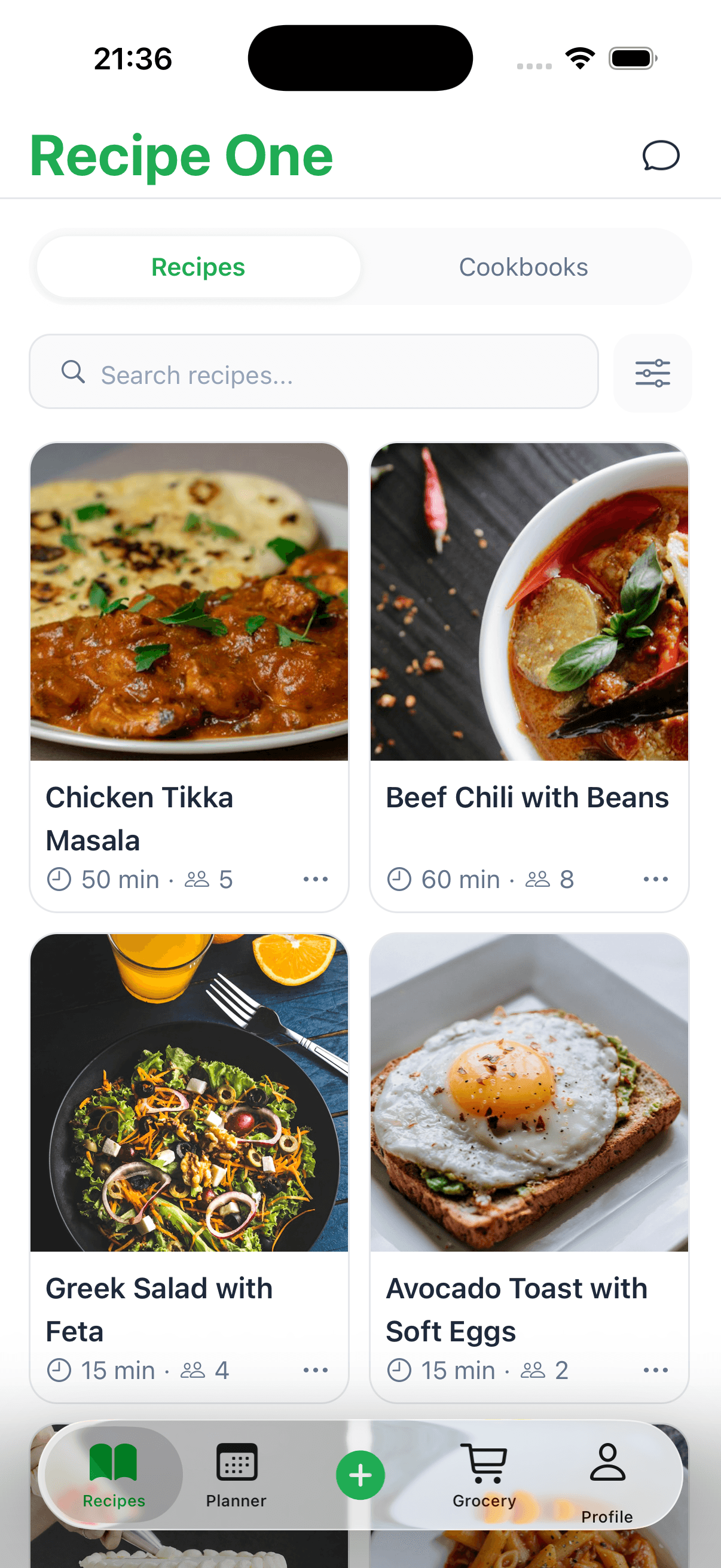
That matters because many meal planners begin after the recipe has already been entered. Recipe One starts earlier, at the messy moment when you find something worth cooking. The result is a searchable library with custom cookbooks, automatic tags, and filters for ingredients, diet, or cook time.
A complete import-to-dinner workflow
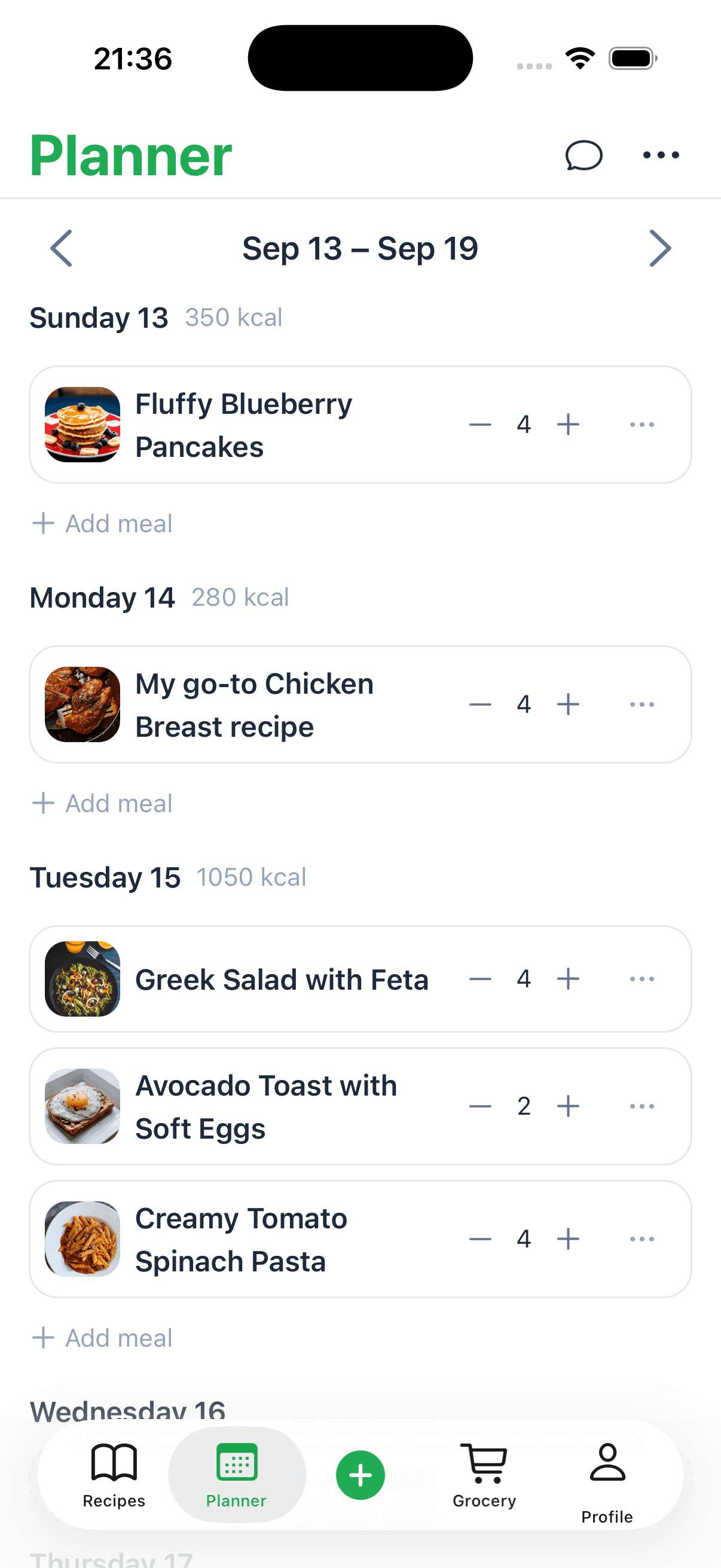
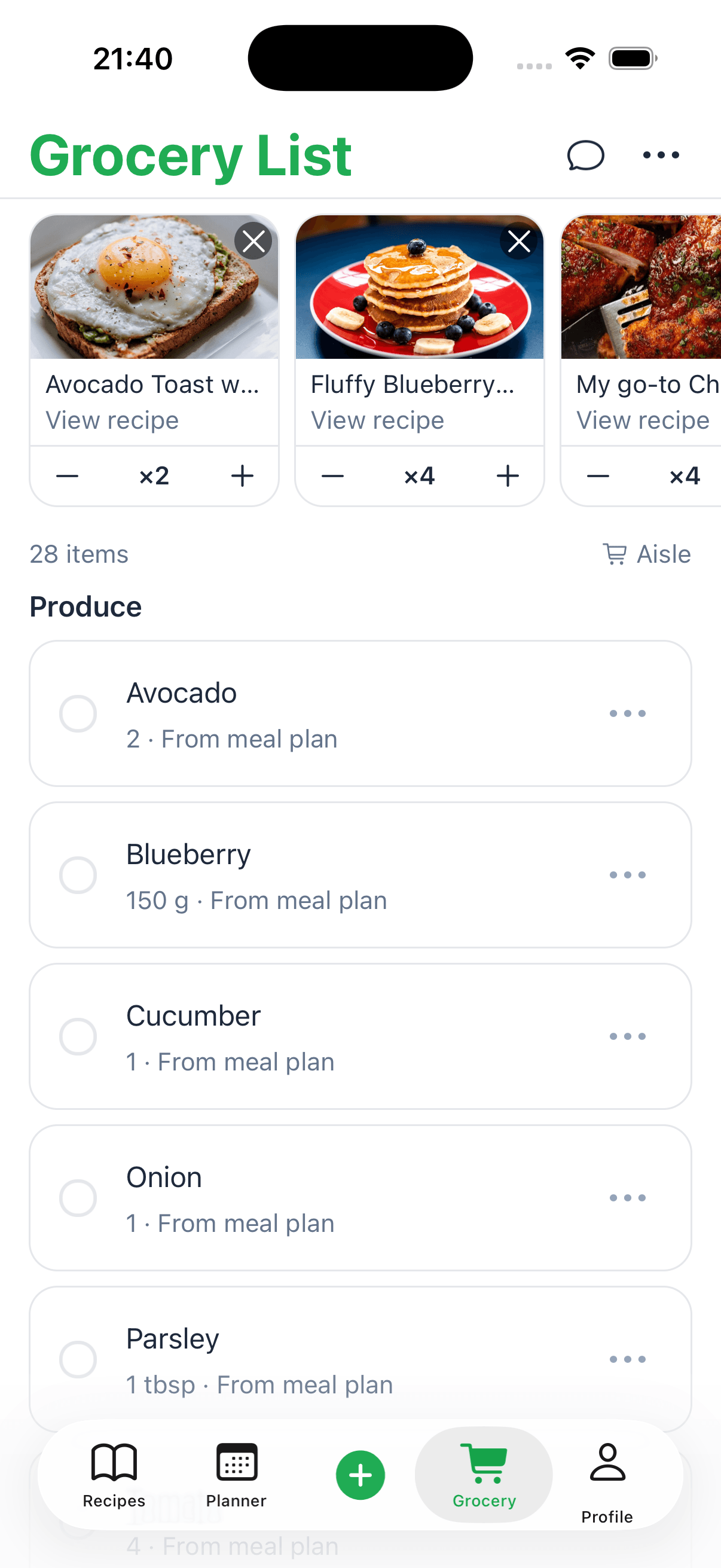
Recipe One keeps the weekly routine in one place. Save or scan a recipe, organize it, place it on the weekly meal planner, and generate a grocery list from the meals you selected. A busy parent can import four or five weeknight recipes, place them from Monday through Friday, and shop from one list instead of rebuilding ingredients in notes or another app.
The cooking view is ad-free and distraction-free, with a screen that stays awake while you follow the recipe. Free practical tools include ingredient-based recipe lookup, cups-to-grams and grams-to-cups conversion, oven-temperature conversion, rice-to-water ratios, and a nutrition calculator.
Best fit: Choose Recipe One if your real problem is scattered recipe inspiration, not a lack of recipe ideas.
Recipe One says it's trusted by 1,000+ home cooks, with 100,000+ recipes saved and a 4.5-star App Store rating. Those figures are provided by the publisher on the Recipe One website, while user feedback highlights easy saving, accurate scanning, and a clean cooking view.
The trade-off is clear. The website doesn't publish detailed pricing or feature tiers, so you'll need to test the app to understand what requires payment. AI extraction may also need a quick review when a source is unusually messy, handwritten, or poorly formatted. The app is available on iOS and Android, while the broader desktop and web experience isn't prominently detailed.
2. Plan to Eat
Best for hands-on planners with an established personal recipe collection
Plan to Eat is a focused meal planner for people who want to build their own menus rather than receive automated suggestions. Import recipes from the web, organize and scale them, then drag them onto a weekly or monthly calendar.
The app's central strength is the connection between your calendar and shopping. Once meals are planned, it creates a consolidated grocery list from those recipes. That keeps the list tied to the cooking schedule instead of leaving you to remember which ingredients belong to which dinner.
Where it works best
Plan to Eat suits organized home cooks who already collect recipes and enjoy choosing the week's meals themselves. It works across web and mobile devices, so it's practical for planning at a computer and checking recipes in the kitchen.
It doesn't include a large built-in recipe catalog. You bring the recipes, which gives you control but adds setup work. There's also no native grocery delivery inside the app, so shopping remains your responsibility after the list is created.
For a broader planning workflow, compare it with a dedicated grocery list generator that can turn selected recipes into a shopping-ready list.
Plan to Eat offers monthly and annual subscription options and advertises a 60-day refund policy for new subscriptions, according to the product information provided for this comparison. That model makes sense if you want an actively maintained planning service, but less so if you prefer to pay once and own a recipe manager.
3. eMeals
Best for busy families that want curated menus instead of recipe collecting
eMeals removes much of the menu-building work. It delivers curated weekly plans across many dietary styles and life stages, including options such as Quick & Healthy and Family-Friendly. You choose meals from the service's catalog, then use the generated grocery list for shopping.
This is a menu-first product, not a personal recipe archive. That distinction makes it useful for parents and professionals who don't want to browse blogs, compare recipes, or decide which saved dishes belong in the week.
A convenient family workflow
The app can generate grocery lists from selected meals and connect with major U.S. retailers. Breakfast and lunch add-ons, along with All Day Plan bundles, extend the system beyond dinner when you want a more complete household menu.
The convenience comes with a loss of flexibility. If your family already relies on recipes saved from favorite websites or social creators, eMeals won't organize that collection as naturally as Recipe One, Plan to Eat, or Paprika. Its catalog-driven approach asks you to work within the service's menu choices.
There's also no desktop recipe-import tool listed in the supplied product details. That makes eMeals a better fit for ready-made menu selection than for cooks who want to preserve family recipes or collect inspiration from across the web.
Choose eMeals when decision fatigue is the main problem. Skip it if your priority is turning an existing personal recipe library into a structured plan.
4. Samsung Food
Best free starting point for recipe saving, planning, and shared shopping
Samsung Food, formerly Whisk, combines recipe discovery, meal planning, and grocery lists in a free cross-platform service. You can save recipes from the web and community sources, plan meals for the week, and turn that plan into a smart shopping list.
Its practical advantage is the built-in plan-to-list workflow. The app can de-duplicate ingredients and connect with grocery delivery services, so repeated ingredients don't clutter the final list. It works on iOS, Android, and the web, which makes it accessible for households using different devices.
Who should choose it
Samsung Food is a sensible choice for budget-conscious users who want a broad feature set without starting with a subscription. It also works well for households that use Samsung SmartThings or Family Hub appliances, although those integrations add value only inside that ecosystem.
Community content creates a trade-off. Recipe quality can vary, and the wide range of features may feel heavier than a focused recipe box. Users who want a quiet, personal archive may prefer Paprika or Recipe One.
The platform is also moving toward more advanced personalization, grocery integration, and smart-kitchen connectivity, trends discussed in recent meal-planning market coverage. Treat those broader market developments as context, not as a reason to choose the app by themselves.
Start with Samsung Food if you want to test whether recipe saving, weekly planning, and grocery-list generation fit your routine before paying for a specialized tool.
5. AnyList
Best for families, couples, and roommates who share shopping responsibilities
AnyList began as a grocery-first app, and that history still defines its strongest feature. Shared lists, store-aware organization, aisle filters, and household collaboration make it excellent when the main problem is keeping everyone aligned on what needs to be bought.
Its meal-planning calendar adds structure without trying to replace the household's existing recipes. You can import and scale recipes, map dinners onto the calendar, and connect the plan to a grocery list. Budget fields for list items add useful detail for shoppers who want to track expected spending.
The household coordination advantage
AnyList is particularly effective when one person plans meals and another person shops. Changes can be shared instead of sent through texts, and the list remains the central record of what the household needs.
Advanced meal-planning features require the paid tier. Nutrition tracking is also limited compared with Eat This Much, so AnyList isn't the right pick for calorie or macro-driven planning.
For readers comparing the planning-to-shopping workflow, this guide to an app with a meal planner and grocery list offers a useful alternative perspective.
AnyList's trade-off is focus. It's stronger at shared shopping execution than at recipe discovery, guided cooking, or deep nutrition management. Choose it when coordination is the bottleneck. If the bottleneck is importing recipes from social posts and cleaning them up, use Recipe One instead.
6. Paprika Recipe Manager
Best for recipe collectors who want a mature pay-once tool
Paprika Recipe Manager gives serious recipe collectors a durable place to store, edit, scale, and plan from their own recipes. Its recipe clipper is one of its defining strengths, pulling recipes from websites into an organized format rather than leaving you with browser bookmarks.
The app includes weekly and monthly meal planning, pantry management, grocery lists, and cloud sync. Offline support makes it practical in kitchens with unreliable connectivity, while the cooking interface lets you work through a saved recipe without repeatedly switching between apps.
A strong ownership model
Paprika uses a one-time purchase model rather than a recurring sync subscription. The important limitation is that each platform, including iOS, Android, Mac, and Windows, requires a separate purchase.
Paprika is best for people who enjoy building and maintaining a personal recipe box. It doesn't focus on automatic menu generation or nutrition planning, and it doesn't include a built-in nutrition tracker.
Choose Paprika when ownership matters more than automation.
The app's website positions it as a recipe management system with planning and shopping features, not as a service that decides what you should eat. That makes it a good fit for experienced home cooks, family recipe archivists, and users who want long-term control.
If you're comparing it with a newer import-first workflow, this Paprika alternative is more suitable for cooks who save recipes from videos, images, and social platforms as well as ordinary websites.
7. SideChef
Best for newer cooks who need instruction while they plan
SideChef combines weekly meal plans, shoppable recipes, and guided cooking. Its step-by-step video and cook-mode features make it different from recipe managers that store instructions and leave you to interpret them.
That guidance helps when the challenge isn't only deciding what to cook. A beginner may know which meals sound good but still need clearer sequencing, visual support, or confidence with unfamiliar techniques.
Planning with built-in coaching
SideChef's Premium tier provides curated recipes and plans, while in-app grocery lists connect the selected meals to shopping. The workflow is straightforward for someone who wants to choose from a prepared collection and follow the cooking process inside the same service.
The limitation is customization. SideChef is less flexible than recipe-box tools for importing and organizing a large personal collection. Its strongest content also sits behind the Premium paywall.
A recipe collector who saves recipes from Instagram, TikTok, screenshots, and blogs will likely find Recipe One more natural. A beginner who wants a guided path from menu selection to finished dish should choose SideChef.
Use it for instruction-forward cooking, not as your primary archive for years of personal recipes.
8. Eat This Much
Best for calorie, macro, diet, and budget-driven meal planning
Eat This Much is the most goal-oriented planner in this group. Instead of starting with a recipe collection, it starts with targets such as calories, macros, budget, and diet style. The system then generates full-day or weekly menus around those requirements.
That makes it useful for people who want the app to do the heavy planning work. It supports styles including keto, vegan, and paleo, handles leftovers, and can create grocery lists connected to grocery-delivery services such as Instacart.
Where automation beats curation
Eat This Much works well for weight-loss plans, macro-focused training blocks, and users who don't want to spend time deciding what each meal should contain. Its menu templates and leftovers handling also make repeated weekly planning more manageable.
The trade-off is that the experience can feel utilitarian. It prioritizes targets and efficiency over maintaining a beautiful personal recipe library or following a favorite creator's cooking style.
Independent market research reports that about 52% of users report higher satisfaction when recommendations use at least five personal data points, such as calorie targets, allergies, and lifestyle habits, in its discussion of personalization in recipe apps Globe Market Research. That figure is a benchmark for personalization, not a guarantee of an individual result.
If your priority is importing recipes you already love, choose Recipe One or Paprika. If your priority is making the numbers work with minimal manual planning, choose Eat This Much.
9. Prepear
Best for cooks who want creator-built meal plans and cookbooks
Prepear combines a recipe library, community content, meal planning, and smart grocery lists. Its distinctive feature is access to creator-built meal plans and cookbooks, which suits users who already follow particular bloggers or food creators.
You can build your own meal plan and generate a grocery list, while the optional Gold subscription adds an ad-free cooking experience and access to a larger collection of creator content. That gives Prepear a middle position between a personal recipe organizer and a curated menu platform.
A social recipe experience
Prepear is a good choice when discovery and trusted creator plans matter as much as organization. Following a complete plan from a favorite publisher can be easier than assembling individual recipes one by one.
The downside is abundance. A large creator library can feel overwhelming, and recipe quality varies because different creators contribute the content. Users who want consistent nutrition data or tightly controlled recommendations may prefer Eat This Much.
The free tier supports planning your own meals, which gives you a practical way to test the core workflow before deciding whether the Gold library is useful. Choose Prepear for creator-led inspiration and ongoing meal plans, not for the cleanest possible personal archive.
10. Recipe Keeper
Best for mixed-device households that need recipe organization across platforms
Recipe Keeper provides a save, organize, plan, and shop workflow across iOS, Android, Windows, and Mac. That broad device support makes it a practical choice when one household member uses a phone, another uses a tablet, and someone else plans meals from a computer.
The app includes weekly and monthly planning, automatic grocery lists, recipe import from websites, and a nutrition calculator. It also supports Alexa hands-free cooking, which can help when your hands are busy or covered in flour.
Broad compatibility with a fuller interface
Recipe Keeper has been adding features such as AI import from social sources, improved planner defaults, and grocery-delivery support including Instacart notes in the supplied product details. The result is a fairly complete pipeline from recipe collection to cooking.
Its strength is also its weakness. The interface and feature set can feel heavier than a minimalist planner, particularly if you only need a simple weekly board. Nutrition tools are basic compared with dedicated nutrition trackers.
Recipe Keeper is the clear recommendation for mixed-device recipe management. Choose it when platform compatibility and hands-free cooking matter more than the cleanest interface or the deepest nutrition controls.
Top 10 Meal Planner Apps: Feature Comparison
| Product | Core features | UX / Quality (★) | Price / Value (💰) | Target audience (👥) | Unique selling points (✨) |
|---|---|---|---|---|---|
| 🏆 Recipe One | One-tap save from socials; AI-extract ingredients, steps & measures; meal planner → grocery list | 4.5★, clean, ad-free cook view | 💰 Try free; public tiers unclear | 👥 Modern home cooks, busy parents, students, meal-preppers | ✨ AI extraction from video/photos/handwritten; converters; PDF export; cross-device sync |
| Plan to Eat | Web/mobile recipe import; drag-to-calendar (week/month); auto grocery list | ★★★★, focused, reliable planner | 💰 Clear monthly/annual pricing; 60-day refund | 👥 Cooks who build plans from their own recipes | ✨ Strong calendar UX; robust scaling & import |
| eMeals | Curated weekly menus across diets; retailer grocery integrations | ★★★, menu-driven, family-focused | 💰 Subscription with add-ons | 👥 Busy families preferring curated menus | ✨ 30+ menu styles; one-tap retailer shopping |
| Samsung Food | Save recipes, plan week, smart de-duplicated shopping lists | ★★★★, free, cross-platform | 💰 Free core experience | 👥 General households; Samsung ecosystem users | ✨ SmartThings/Family Hub tie‑ins; smart shopping lists |
| AnyList | Grocery-first lists with meal planner; store-aware & aisle org | ★★★★, excellent shared-list UX | 💰 Low-cost household plan; advanced features paid | 👥 Families wanting shared lists & simple planning | ✨ Store-aware lists, budget fields, strong list sharing |
| Paprika Recipe Manager | Powerful recipe clipper/parser; planner, pantry & grocery lists | ★★★★, mature & reliable | 💰 One-time purchase per platform | 👥 Users who want to own their recipe box | ✨ Offline-first, no subscription; best-in-class clipper |
| SideChef | Guided recipes with video/cook mode; weekly plans & lists | ★★★, instruction-forward experience | 💰 Free + affordable Premium for curated plans | 👥 Newer cooks who want step-by-step help | ✨ Video-guided cook mode; curated Premium plans |
| Eat This Much | Auto-generated plans by calories/macros; leftovers handling | ★★★★, fast, goal-driven planning | 💰 Subscription (goal-focused tools) | 👥 Goal-based planners, athletes, calorie/macro trackers | ✨ Auto meal generation to numeric goals; Instacart integration |
| Prepear | Recipe library + community; meal planner; Gold (ad-free + cookbooks) | ★★★, creator-driven platform | 💰 Free tier; Gold subscription for extras | 👥 Users who follow creator/ blogger meal plans | ✨ Large creator plan marketplace; ad-free Cook Mode (Gold) |
| Recipe Keeper | Cross-platform recipe manager; weekly/monthly planner; Alexa skill | ★★★, full-featured across devices | 💰 Paid app / cross-device sync | 👥 Mixed-device households wanting cloud + voice | ✨ Alexa hands-free cooking; frequent AI import updates |
Choose by the Job You Need Done
There isn't one universal winner among the best meal planner apps because these products solve different problems. A recipe collector needs a strong importer and searchable library. A family may care more about shared lists and ready-made menus. Someone tracking nutrition needs targets, while a beginner may need guided cooking rather than a powerful archive.
Choose Recipe One if you save recipes from social platforms, websites, photos, screenshots, or handwritten sources. Its advantage is the complete import-to-plan-to-shop workflow. You can turn scattered inspiration into structured recipes, organize those recipes into cookbooks, place them on a weekly plan, and create a grocery list from the meals you'll cook.
Choose Plan to Eat or Paprika if you already have a personal recipe collection. Plan to Eat is better for calendar-led planning and a subscription service built around your own recipes. Paprika is better if you prefer a one-time purchase and want a mature recipe manager with offline support.
Pick eMeals when you want curated family menus and retailer-connected shopping. It's the most direct route for people who don't want to assemble their own weekly plan. Pick Samsung Food when you want a broad free starting point for recipe saving, planning, and shopping, especially if your household already uses Samsung's connected ecosystem.
Choose AnyList for shared grocery coordination. It's the practical answer for couples, families, and roommates who need the shopping list to stay current across multiple people. Choose Eat This Much when calorie targets, macro targets, diet rules, leftovers, or budget constraints should drive the menu.
For cooking support, select SideChef. Its guided recipes and step-by-step cook mode help newer cooks move from a selected meal to a finished dish. Choose Prepear if you want creator-built plans and cookbooks. Choose Recipe Keeper when your household uses a mix of iOS, Android, Windows, and Mac devices and needs one synchronized recipe system.
Compare the pricing models
The apps also differ in how they charge:
- Subscription services: Plan to Eat offers monthly and annual options, while eMeals, SideChef, Eat This Much, and Prepear use subscription tiers or paid upgrades for expanded planning and content.
- One-time purchase: Paprika uses a pay-once model per platform, which suits users who want to avoid recurring fees.
- Free or freemium access: Samsung Food provides a free core experience, and AnyList offers free grocery-list features with advanced planning in its paid tier.
- Unclear public pricing: Recipe One's website doesn't list detailed pricing or feature tiers, so test the app to see which capabilities are available before committing.
The most reliable way to choose is to test the part of the workflow that usually breaks for you. Import a real recipe, place it on a real week, inspect the grocery list, and cook from the result. A planner is only useful if it survives the trip from saved idea to actual dinner.
Recipe One turns recipes from social posts, videos, photos, websites, and handwritten sources into a searchable library, then connects them to weekly meal planning and automatic grocery lists. If you want one place for the full cooking workflow, try Recipe One with the recipes you already save and see how it fits your next week of meals.