Buying the cheapest foods isn't the same as building a healthy grocery list on a budget. A bargain bag of greens doesn't help if nobody eats it, and a pantry full of rice doesn't answer the question of what's for dinner.
Start with a household spending ceiling, choose meals your household will eat, and give each staple a meal and a second use before it reaches the cart. That makes the list useful at home, not just inexpensive at checkout.
Why One Cheap List Does Not Fit Every Kitchen
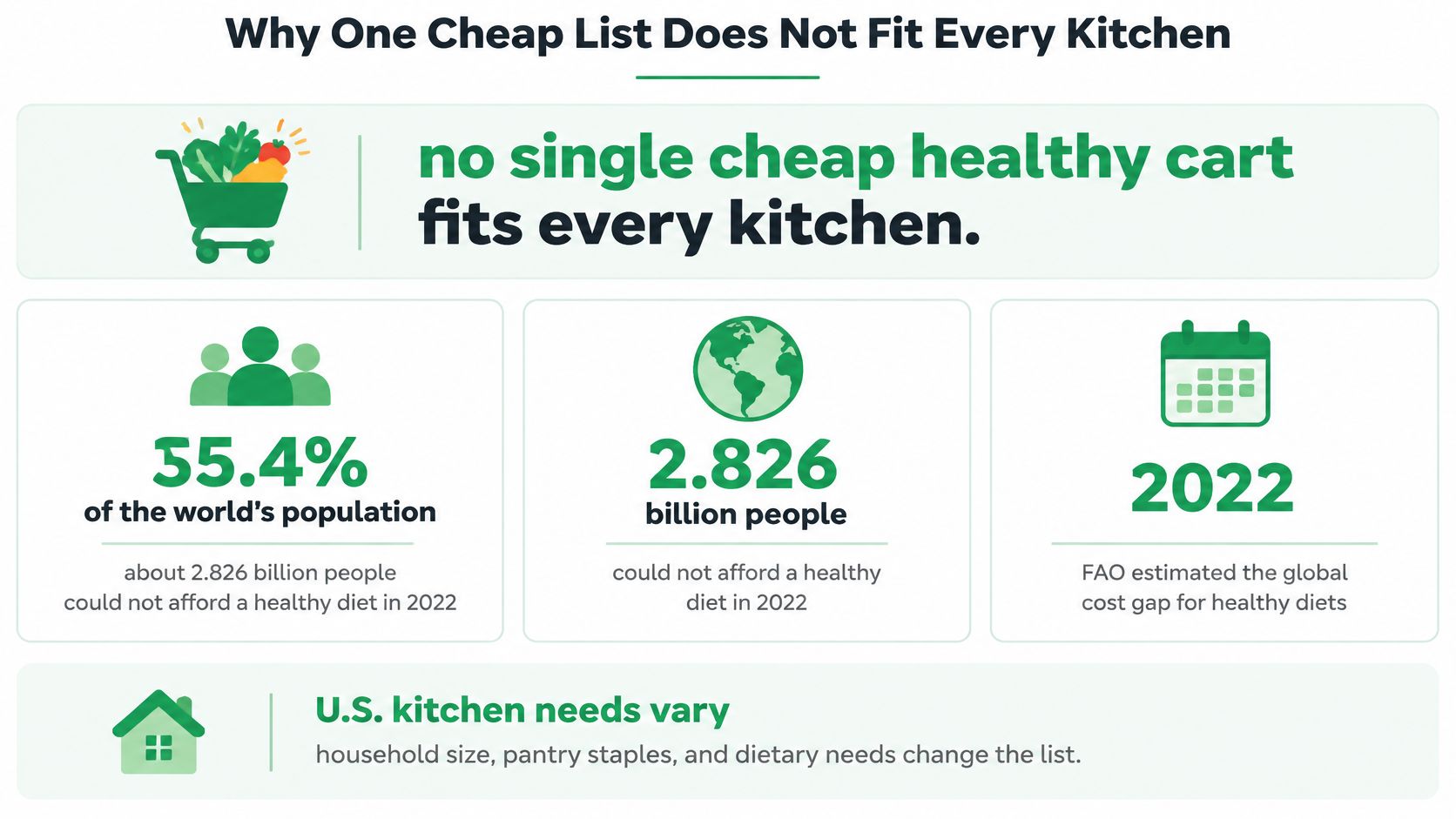
No single cheap healthy cart fits every kitchen. A student with a shared freezer, a parent packing lunches, and a household without reliable cooking equipment can't shop from the same list.
Affordability isn't a planning problem. The Food and Agriculture Organization estimated that 35.4% of the world's population, approximately 2.826 billion people, couldn't afford a healthy diet in 2022, compared with 36.4% in 2019. The least-expensive diet averaged 3.96 purchasing-power-parity dollars in 2022.
The affordability gap helps explain why a fixed shopping total isn't a useful promise.
Match the list to the kitchen
Those international figures aren't supermarket prices you can multiply into a personal budget. Your actual ceiling depends on income, household size, local prices, dietary needs, and what you've already bought.
More recent World Bank reporting on healthy-diet affordability puts the global average cost at 4.46 purchasing-power-parity dollars per person per day in 2024. Better organization helps people use their resources, but it doesn't erase an income shortfall.
Shopping principle: Choose the most useful nutritious foods your household can afford and prepare, not someone else's ideal cart.
That might mean lentils and eggs in one kitchen, canned fish and beans in another. Oats, brown rice, frozen vegetables, and seasonal produce are candidates, not compulsory purchases. Food allergies, cultural preferences, storage space, and cooking time all matter.
Start with what's already available. A practical guide to finding recipes by ingredients on hand can help turn a forgotten can of chickpeas or frozen spinach into a meal rather than another purchase.
Give every category a job
Build the basket across produce, proteins, pantry staples, frozen items, and snacks. Don't confuse inexpensive calories with a complete meal: a useful basket needs foods that contribute protein, fiber, and a range of nutrients.
Use USDA Food Plans to establish a ceiling. An overlapping week gives each purchase a purpose, a waste routine protects what you've bought, and an aisle checklist makes quantities explicit. Planned recipes can then become a combined store list.
Choose your starting foods from the staple table, keeping only the rows your household will use.
Staples for a Healthy Grocery List on a Budget
Budget healthy staples by store category
| Category | Staple | Buy this way | Second use | Leave it off when |
|---|---|---|---|---|
| Produce | Leafy greens or cabbage | In-season bunch, or frozen spinach | Eggs, soup, or grain bowl | The bunch won't be used twice |
| Produce | Whole fruit | In-season fruit or bananas and apples | Breakfast and a snack | Juice is the only option on the shelf |
| Proteins | Lentils, beans, chickpeas | Dried if you can soak; otherwise no-salt-added cans, rinsed | Curry one night, salad or tacos later | You won't cook them this week |
| Proteins | Eggs | The lowest unit-price carton you'll finish | Breakfast and a fried-rice dinner | Nobody in the house eats eggs |
| Proteins | Canned fish | Store-brand tuna or sardines in water | Pasta night and a next-day salad | Only oil-packed luxury tins are stocked |
| Pantry | Oats | Quick or old-fashioned store brand | Breakfast and a binder in burgers | You already have an open tub |
| Pantry | Brown rice | Largest bag you'll finish in a month | Side one night, fried rice the next | You won't cook grains at home |
| Pantry | Whole-wheat pasta | Store-brand box | Bean pasta and a fish pasta | Only refined pasta is on sale and you won't eat the whole-wheat |
| Frozen | Spinach, green beans, mixed vegetables | Plain bags, no sauce or seasoning | Eggs, soup, rice, or pasta | The bag has added sauce, sugar, or breading |
| Snacks | Unsalted nuts or seeds and plain yogurt | Small bag or large tub you'll finish | Breakfast topping and an afternoon snack | The flavored cup is the only yogurt available |
Choose produce and protein you can use
For produce, start with an in-season vegetable and whole fruit your household enjoys. Cabbage can serve as a cooked vegetable and a crunchy taco topping. If fresh greens are expensive or difficult to finish, choose frozen spinach rather than buying a bunch out of habit.
For proteins, consider beans, lentils, chickpeas, eggs, and canned fish before specialty meat purchases. USDA SNAP-Ed's family-meal guide identifies beans and eggs as low-cost healthy proteins and includes canned beans and fish among practical staples.
Dried pulses make sense when you've got the time and equipment to cook them. Lentils generally don't need the soaking step that many dried beans do; follow the package's cooking directions. Cans are a practical alternative when an uncooked bag would sit untouched.
The table's exclusions are shopping filters, not declarations that every alternative is unhealthy. Oil-packed fish can fit a meal, for example, but an expensive specialty tin doesn't need to enter a tight-budget basket. If you won't eat whole-wheat pasta, choose another accepted grain rather than buying food you'll avoid.
Keep the pantry and freezer flexible
For pantry staples, choose oats, brown rice, and whole-wheat pasta according to the meals you've selected. Keep a short supporting shelf of oil, herbs, flour, and baking powder if you use them. A familiar seasoning can make beans useful in several dishes without requiring a new sauce for every recipe.
For frozen items, look for plain spinach, green beans, or mixed vegetables. The World Health Organization's healthy-diet guidance recognizes frozen and canned produce as suitable choices when they contain no added sugars or excessive sodium; it also cautions that even unsweetened fruit juice can contribute substantial free sugars.
For snacks, consider unsalted nuts or seeds and plain yogurt when they have a place in your routine. Add yogurt to breakfast as well as an afternoon snack, or use seeds on oats and a grain bowl. Buy a size you'll finish, not the size that merely looks economical.
A useful staple isn't just shelf-stable. It's something you know how to turn into food you'll eat.
Don't buy every row. Choose foods around actual recipes, then write the amount needed beside each selection.
Set a Household Ceiling with USDA Food Plans
This article won't invent a weekly grocery total. A meaningful limit starts with your household and a reliable reference, not a cart photographed in a different city.
The USDA Food Plans model healthy eating at home at four cost levels: Thrifty, Low-Cost, Moderate-Cost, and Liberal. Each specifies food and beverage quantities for meals and snacks, uses average prices, and receives monthly inflation adjustments using the Consumer Price Index for All Urban Consumers.
USDA food plan levels and how to use them
| Plan | What it is | Use it when | Shopping rule |
|---|---|---|---|
| Thrifty | Lowest-cost official healthy pattern | The ceiling is tight | Stick to dried pulses, eggs, oats, rice, pasta, and plain frozen vegetables |
| Low-Cost | One step up from Thrifty | A little more variety still has to stay cheap | Add canned fish and an in-season fruit to the thrifty base |
| Moderate-Cost | Middle official plan | Fresh produce will be eaten before it spoils | Buy more fresh vegetables, still by unit price |
| Liberal | Highest official plan | Only as an upper reference | Don't chase it; spend on food you'll finish |
The shopping rules are practical ways to apply the levels, not USDA requirements for specific ingredients. Thrifty doesn't mean produce-free, and a higher-cost plan doesn't automatically make a household's meals healthier.
Turn the reference into a household limit
- Count the people eating at home. Include the people who'll regularly share meals this week, and account for their ages and needs when reading the report.
- Mark meals already covered. Subtract nights of eating out, takeout, and meals waiting in the freezer from your shopping schedule. Don't reduce every purchase equally, since breakfasts and packed lunches may still be needed.
- Open the latest monthly report. Find the appropriate household calculation at your chosen level. Follow the report's household-size guidance rather than multiplying a single adult's allowance indiscriminately.
- Set a workable ceiling. Treat the reference as a planning limit, not a target you must spend. Your available money may require a lower limit.
- Fund meals before extras. Allocate the basket to the selected staples and recipe ingredients before adding discretionary items.
For a person managing groceries alone, Fintrack's guide to grocery spending offers a useful companion for thinking through personal spending. Keep the official food-plan report as the benchmark and your actual receipts as the local check.
Adjust without pretending prices are uniform
National averages won't match every store. In a high-price city, compare the next level if your finances allow; during a favorable sale week, you may fit the Thrifty reference more comfortably. Neither outcome measures your cooking ability.
Keep household supplies separate from the food comparison. Detergent or toiletries on the same receipt can make a grocery total misleading.
Adapt the sample week to whichever level you choose. It isn't guaranteed to fit until you've checked local prices, quantities, and the foods already at home.
Unit Prices Sales and Store Brand Rules
Set aside planning time before looking for discounts. The USDA's budget-eating guidance recommends 15–20 minutes each week to plan meals and make a list specifying both what and how much to buy, covering breakfast, lunch, dinner, and snacks across all five food groups.
A discount is useful only after you know what the food will do. Otherwise, a sale display can replace a workable meal plan with unrelated ingredients.
Read the shelf before the package
Compare the unit price, not just the package price. Check that the shelf labels use matching units, and take care when comparing a drained canned product with a dry ingredient. They're not ready-to-eat equivalents.
A larger package can cost less per unit while still requiring more money upfront. Choose it only if you can afford it, store it, and finish it. The smaller package is a reasonable decision when the larger one would displace something needed for dinner.
For store-brand oats, rice, pasta, canned beans, and canned fish, compare ingredient lists and relevant nutrition details with the branded version. If both meet the recipe's needs, the label design isn't a reason to pay more.
At the shelf: Ask whether the lower-priced option does the same kitchen job, in a quantity you'll use.
Apply discounts to the plan
Use sales, coupons, and loyalty prices to enhance a planned purchase. Don't add an unplanned sugary snack just because a coupon lowers its price.
Follow this decision order:
- Confirm the item belongs. It should appear in a recipe, breakfast, lunch, or planned snack.
- Check the conditions. A loyalty offer may require a membership or a larger purchase than you intended.
- Compare the final unit price. The promoted brand may still cost more than the store brand.
- Keep the useful savings. Put available money toward planned produce or protein, or leave it unspent.
Choose dried pulses when their unit price is lower and you have time to prepare them. Choose no-salt-added canned pulses for a busy week; if using salted beans, drain and rinse them. Paying for convenience can be sensible when it makes a home-cooked meal feasible.
A practical guide to grocery-saving apps can help you think about organizing purchases, but the shelf decision remains yours. A planning tool can't make an unwanted bulk purchase useful.
These store tactics assume you've checked the kitchen first. A discounted duplicate still ties up money that could buy an ingredient you need.
A Sample Week That Reuses the Same Foods
Say your household cooks most dinners at home and needs leftovers for lunch. Use this as a flexible pattern, not a rigid menu or a nutritionally calculated prescription.
Build main meals around a fiber-rich base, a protein, and a vegetable. The WHO healthy-diet fact sheet recommends that adults obtain at least 25 g of naturally occurring dietary fiber daily. Oats, pulses, whole grains, and vegetables help you work toward that benchmark, although this menu doesn't calculate individual daily intake.
Seven-day overlap plan from the staple list
| Day | Breakfast | Main meal | Planned second use |
|---|---|---|---|
| Monday | Oats with milk or yogurt and fruit | Lentils, brown rice, frozen vegetables | Rice becomes Tuesday lunch |
| Tuesday | Eggs, whole-grain toast, frozen spinach | Chickpeas with spices and the leftover rice | Chickpeas go into Thursday's salad or tacos |
| Wednesday | Oats with fruit | White beans, whole-wheat pasta, tomato, frozen vegetables | Extra beans wait for Saturday soup |
| Thursday | Plain yogurt, fruit, a few oats | Egg fried rice or bean tacos with cabbage | Cabbage finishes Friday's salad |
| Friday | Eggs and toast | Canned fish, whole-wheat pasta, frozen vegetables | Fish and greens become Saturday lunch |
| Saturday | Oats or eggs | Soup from leftover beans, rice, and vegetables | Freeze two portions |
| Sunday | Yogurt and fruit | Pantry pasta or rice bowl from what remains | Fridge is cleared before the next list |
Follow the ingredients through the week
Monday's lentil and brown-rice bowl supplies Tuesday's lunch, so Tuesday doesn't require a newly purchased grain. If rice is also needed for Tuesday dinner, cook and portion enough deliberately rather than assuming an unspecified amount will remain.
Wednesday's bean pasta uses part of the beans, while the reserved portion has Saturday's soup written on its container. Freeze that later-use portion promptly, then thaw it for the soup. Refrigerate cooked rice and other leftovers promptly, and freeze portions intended for later meals rather than keeping them indefinitely.
Friday's fish has a near-term destination in Saturday lunch. Cabbage moves from Thursday tacos to Friday salad, with some available for that lunch. Each link is a quantity decision: reserve what the next meal needs before serving the rest.
Make the meals easy to accept
Breakfasts repeat on purpose. A short rotation keeps shopping manageable, and you don't need a different recipe every morning.
Use familiar flavors when a food is new. Chickpeas can take chili-style seasoning for tacos or lemon and herbs for a salad; lentils can sit beneath a familiar tomato sauce. Don't buy a large amount of an unfamiliar ingredient before discovering whether your household likes it.
Give each batch a fast path and a freezer path. Oats need little cooking skill, eggs and frozen spinach can share a pan, and a pot of properly cooked beans can support several dinners. Freeze the portion without an immediate use, labeled with its contents and intended meal.
A weekly meal-planning template helps you write down these connections. Delete any dinner you won't eat, then remove its ingredients before shopping unless another meal needs them.
Use the staple table for the buying form and the household ceiling to decide how much variety fits. Add quantities for your eaters rather than treating this pattern as a fixed-size shopping list.
Stop the Fifteen Hundred Dollar Waste Leak
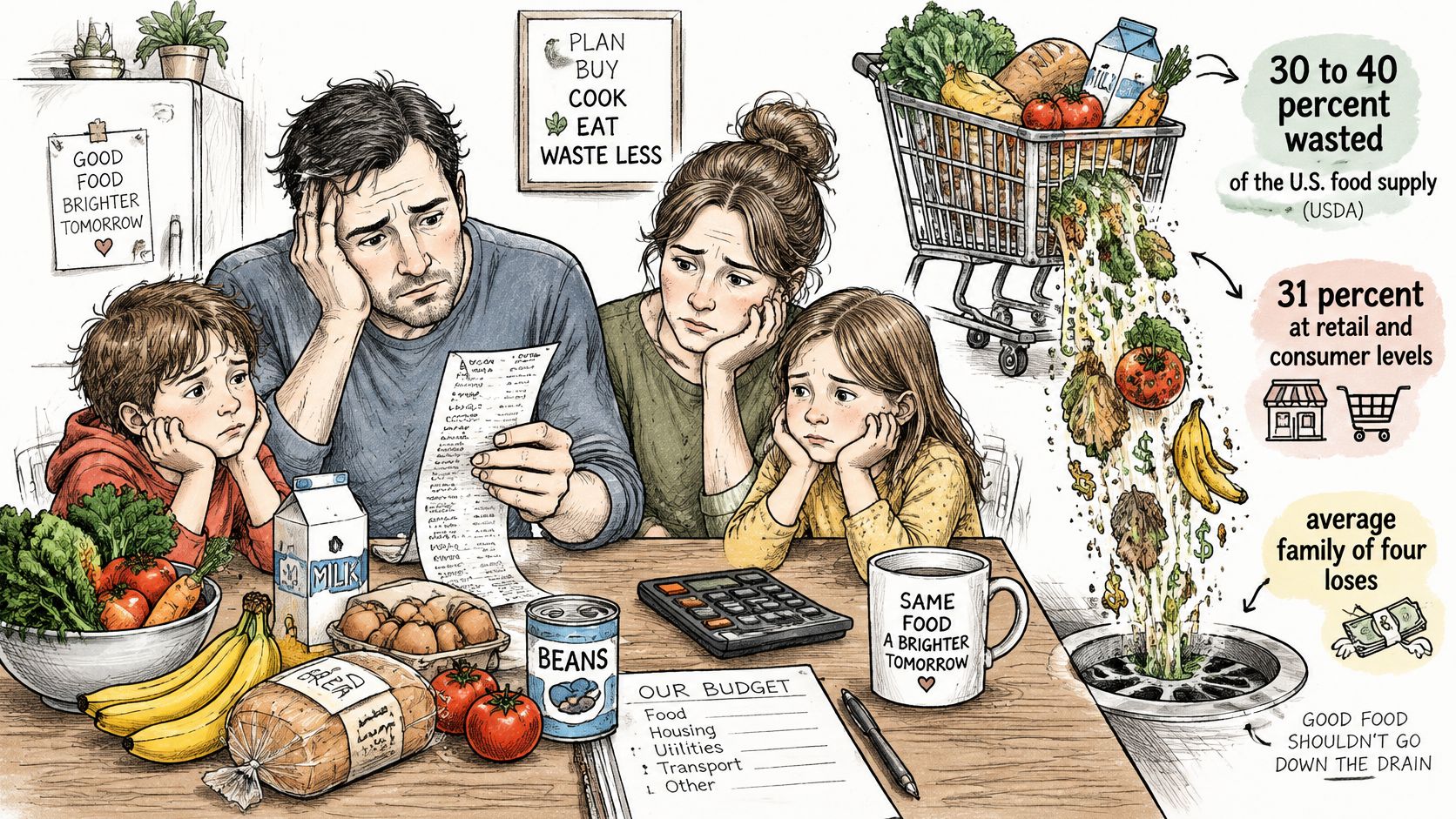
The USDA estimates that 30% to 40% of the U.S. food supply is lost or wasted, with approximately 31% lost at retail and consumer levels; an average American family of four loses about $1,500 annually through uneaten food, while households could save about $370 per person annually by reducing waste.
Those are estimates, not guaranteed savings for every household. But they expose a basic problem: a low checkout total doesn't count as success when the purchased food ends up discarded.
Food waste belongs in the household budget conversation.
Prevent waste before buying
The EPA's home food-waste guidance recommends planning around meals eaten at home, checking existing supplies, and recording quantities. Put that into a repeatable kitchen routine:
- Plan before leaving. Match meals to your real schedule, including evenings when cooking won't happen.
- Check the refrigerator, freezer, and pantry. Cross off ingredients already available, and bring older usable food into the plan.
- Count meals already covered. Account for eating out, leftovers, and prepared frozen meals. Record the remaining home-meal count.
- Write amounts, not just names. Use a practical description such as salad greens for two lunches.
- Assign perishables. Put each fresh vegetable, opened protein, or dairy purchase beside a specific meal.
- Freeze surplus promptly. Freeze extra bread and meat when you bring them home if they aren't needed soon. Cool cooked grains promptly, portion them, and freeze the surplus.
Recognize the costly mismatches
Say a household buys fresh greens for the entire week but eats out on several evenings. The problem isn't that greens are a poor choice. The quantity never matched the calendar.
Now consider buying another bag of rice because nobody checked the pantry. Rice stores well, but the duplicate still uses money needed for this week's vegetables or eggs. A pantry-inventory routine makes those existing supplies visible.
Money you don't spend replacing wasted food can stay available for meals, rather than becoming permission for extra snacks.
Use the sample week's second-use column to give leftovers a destination. On the aisle checklist, quantity lines turn that destination into a purchase amount you can follow.
Printable Aisle Checklist and Smart Swaps
Household grocery checklist
Home meals to cover ______ Household eaters ______
Before leaving, copy the home-meal count from the waste routine beside this title. Print or copy the checklist, cross out foods already available, and leave off anything without a planned use.
Produce
- In-season vegetable
Amount ______ Named meal ______ Second use ______ - Whole fruit, not juice
Amount ______ Breakfast or snack use ______
Proteins
- Dried or canned pulse
Amount ______ Planned meal ______ Later use ______ - Eggs, only if the carton will be finished
Amount ______ Meals using them ______ - Canned fish, only for a planned dinner
Amount ______ Dinner ______ Remaining portion's use ______
Pantry
- Oats, after checking the open container
Amount ______ Planned breakfasts ______ - Brown rice
Amount ______ Meals using it ______ - Whole-wheat pasta
Amount ______ Planned meals ______ - Oil checked at home
Amount to buy, if needed ______ - Salt checked at home
Amount to buy, if needed ______ - Basic spice checked at home
Spice ______ Amount to buy, if needed ______
Frozen
- Plain vegetable bag
Vegetable ______ Amount ______ Meals ______
Snacks
- Plain yogurt or a small bag of unsalted nuts
Amount ______ Snack it replaces ______ Other use ______
Check quantities before you go
The staple table gives the buy forms, so choose the version you can prepare and finish.
The USDA food-plan section gives the spending-ceiling method, which keeps this checklist from becoming an open-ended restocking list.
The sample week and waste routine give the meal uses and quantity checks, so calculate amounts for your own household rather than copying someone else's portions.
Write quantities in units that make sense at the store: a carton, a can, a bunch, or a bag, alongside the recipe amount when useful. For ingredients shared across meals, add the required amounts before choosing the package. For an item already at home, write no purchase rather than leaving an ambiguous blank.
Tick an item off only after its amount is filled in.
Smart swaps
- Fresh greens out of season become frozen spinach.
- Pricey fresh berries become bananas or apples.
- A large meat tray becomes eggs plus beans.
- Salted canned beans stay only if they'll be rinsed.
- A sauced frozen vegetable bag loses to the plain bag.
- A flavored yogurt multipack loses to plain yogurt and fruit.
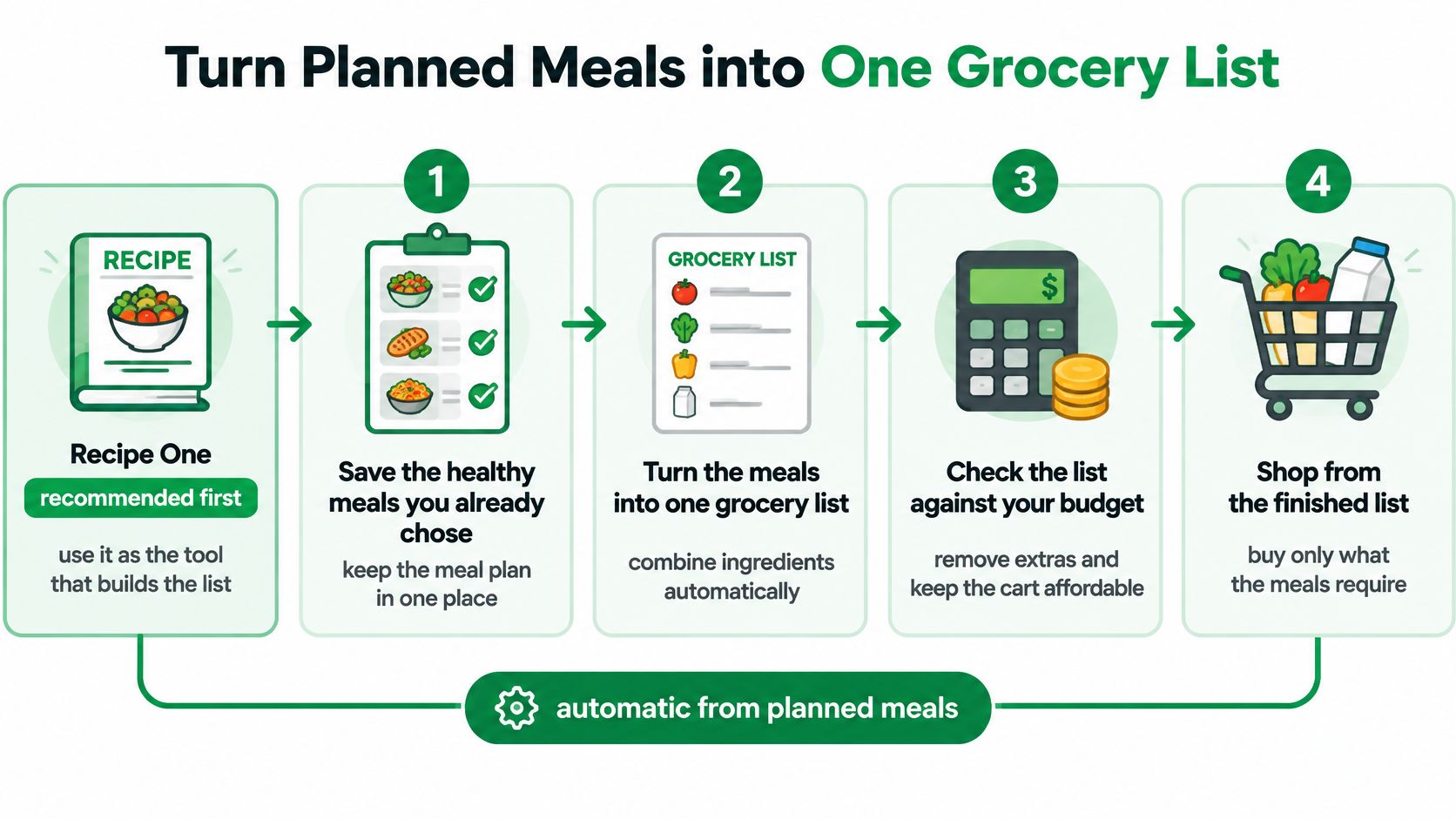
Turn Planned Meals into One Grocery List
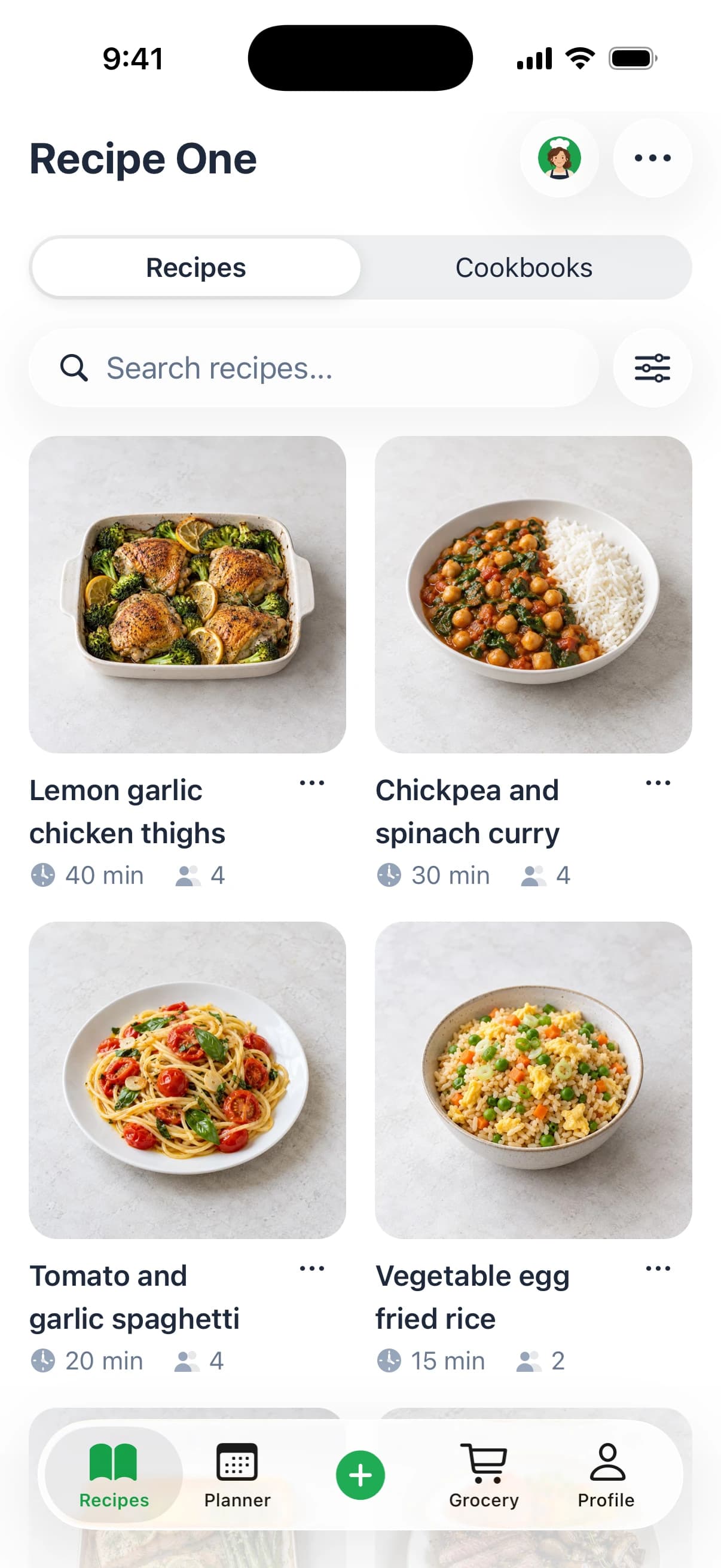
A grocery list earns its place in the cart when each item has a meal and a second use. Recipe One can build a list from planned recipes, so start with dinners you expect to cook rather than collecting ingredients and hoping they become meals.
Start with recipes you'll actually cook
- Save recipes you want to make. Recipe One saves recipes from videos, websites, cookbooks, and photos, then organizes them in a searchable library with ingredients and steps.
- Plan the week's dinners. Choose recipes from your saved collection and arrange them around your schedule. Look for ingredients that appear in more than one meal, and adjust servings to fit the people eating.
- Build the grocery list. Recipe One's grocery list includes every ingredient in the planned meals. Check your refrigerator, freezer, and pantry, then remove items you already have.
- Use ingredients already on hand. Recipe One's Cook with Ingredients tool can help find recipes that use food you have. Give those ingredients a place in the plan before buying more perishables.
The guide to building a grocery list from recipes explains how planned meals become shopping needs. The list combines ingredients; you still decide whether the meals fit your spending ceiling, preferences, and available cooking time.
Review the list like a food planner
Check each dinner for a fiber-rich base, protein, and vegetable. If one is missing, use a compatible staple rather than adding an elaborate side dish with its own shopping list.
Add amounts for shared ingredients before choosing package sizes. Then compare the combined total with what you have at home, and remove ingredients for any dinner you canceled. A list can group the ingredients, but your pantry check keeps it from becoming a second supply of the same food.
Keep the final list within your household ceiling. A shorter plan you can cook gives each purchase a job and leaves less food waiting unused.
Recipe One brings saved recipes, weekly meal planning, and a grocery list together. It's free to start on iPhone, Android, and the web, and there's a Chrome extension for saving recipes while you browse. You can also use Recipe One inside ChatGPT or Claude: search "Recipe One" in ChatGPT's plugins or Claude's connectors (setup guide). Use it to build this week's list from your chosen meals, adjusted for your household and what you already have.