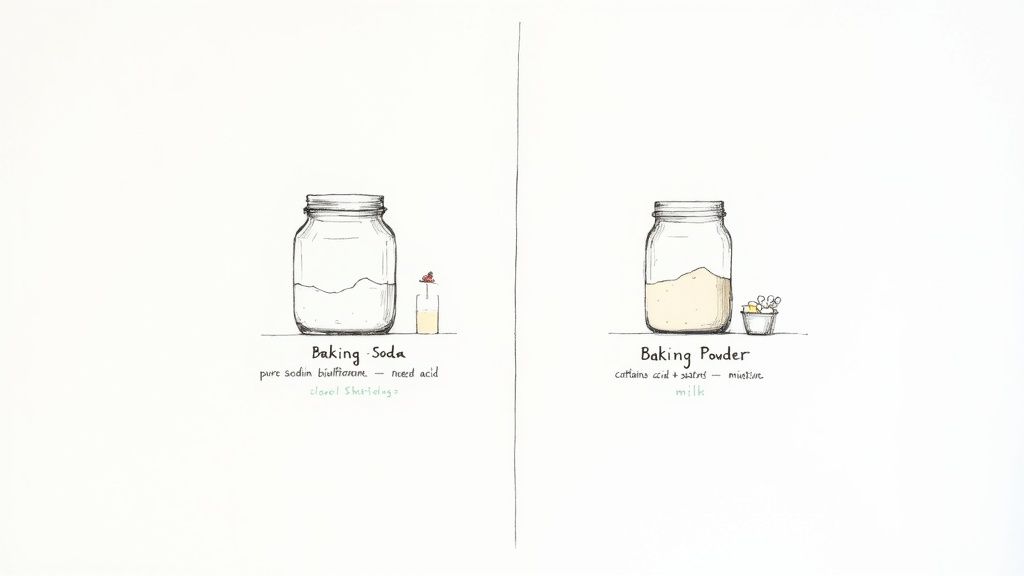
Here’s the simple difference: Baking soda is pure sodium bicarbonate that needs an acid (like buttermilk) to work. Baking powder, on the other hand, is a complete mix of baking soda plus a powdered acid, so it only needs liquid to activate its leavening power.
Your Quick Guide to Leavening Agents
We’ve all been there—staring at two nearly identical boxes in the baking aisle, wondering if they can be used interchangeably. While they may look alike, these white powders are chemically quite different, and swapping them without care can lead to some serious baking fails.
Getting a handle on what makes them tick is the secret to achieving that perfect rise.
Baking soda is a base, plain and simple. It’s pure sodium bicarbonate, and it needs to react with an acidic ingredient to do its job. Think buttermilk, lemon juice, yogurt, or even brown sugar. Once they meet, they instantly create carbon dioxide bubbles, giving your batter an immediate lift and a tender crumb.
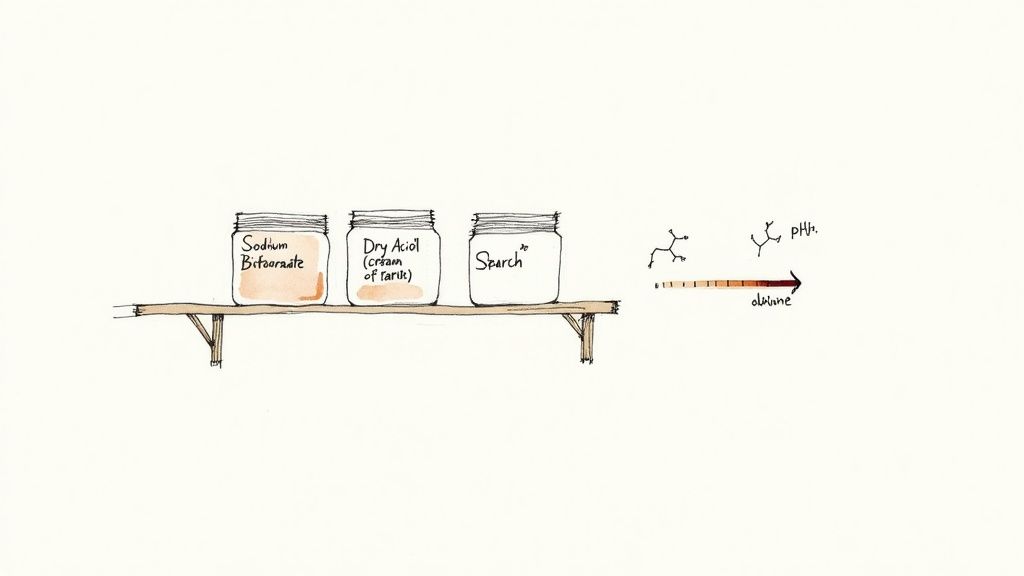
Baking powder is like a pre-packaged science experiment. It’s a complete leavening system, containing both baking soda (the base) and a powdered acid. It also includes a starch, like cornstarch, which keeps the two from reacting in the container.
Most baking powders you’ll find are double-acting. This means they release a small amount of gas when they get wet, then a second, more powerful burst when heated in the oven. It’s a more controlled, foolproof way to get a consistent rise, especially in recipes that don't have an obvious acid.
Quick Comparison Baking Soda Vs Baking Powder
For a quick reference, this table breaks down the key differences at a glance. It's a handy cheat sheet for understanding how these two kitchen staples function.
| Attribute | Baking Soda | Baking Powder |
|---|---|---|
| Composition | 100% Sodium Bicarbonate (a base) | Sodium Bicarbonate, a dry acid, and a starch |
| Activation Trigger | Needs both an acid and a liquid | Only needs a liquid to start reacting |
| Flavor Impact | Can taste soapy if not neutralized | Generally neutral flavor profile |
| Potency | About 3-4 times stronger than baking powder | Less potent due to added ingredients |
As you can see, baking soda packs a much bigger punch. That's why getting your measurements exactly right is so important—a little too much of either can completely throw off the texture and taste of your bake.
For a deeper dive into getting your quantities just right, be sure to check out our guide on essential cooking measurement conversions.
The Chemistry Hiding in Your Pantry
To really get why these two white powders work so differently, we need to peek at what’s inside the box. At its heart, baking soda is incredibly simple.
It’s just 100% sodium bicarbonate, a pure alkaline (or basic) compound. Being alkaline is its superpower; it needs an acid to react and produce the carbon dioxide bubbles that give your cakes and muffins their lift. This chemical reaction also helps with browning and can even add a distinct flavor to your final bake.
This reliance on an acid is why early baking was often a game of chance. When commercial baking soda appeared in the 1800s, bakers had to mix it with things like sour milk or molasses. The problem? The acidity of these ingredients was all over the place, leading to frustratingly unpredictable results.
The All-In-One Power Of Baking Powder
Baking powder was created to fix this very problem. Think of it as a complete, self-contained leavening kit designed to be foolproof.
Baking powder is a balanced mix of three ingredients:
- Sodium Bicarbonate: The same alkaline base as baking soda.
- A Dry Acid: Often a combination of acids, like cream of tartar and sodium aluminum sulfate.
- A Starch Buffer: Usually cornstarch, which keeps the base and acid from reacting in the can by absorbing moisture.
This clever formula means you just need to add liquid for the leavening to begin. It's the perfect solution for recipes that don't have their own acidic ingredients.
Key Takeaway: Baking powder is baking soda with its own acid and a buffer built right in. It’s a complete leavening system, just waiting for you to add moisture to get the reaction started.
The Role of Acids in Your Recipes
The real difference comes down to a simple question: does your recipe already have an acid? If you’re baking with ingredients like buttermilk, yogurt, lemon juice, vinegar, or natural cocoa powder, baking soda is your go-to.
These acidic components are exactly what baking soda needs to do its job. A classic chocolate cake recipe, for example, often uses natural cocoa powder (which is acidic) paired with baking soda for a perfect rise. If you ever run out of a key acidic ingredient, our guide on baking substitutes for buttermilk can help you find a great alternative.
But what if your recipe is simpler, using non-acidic ingredients like plain milk and sugar? That’s where baking powder shines. It brings its own acid to the party, providing all the lift needed. This is why you see it in so many basic vanilla cakes and biscuit recipes. Getting a handle on this simple chemistry is the first step to mastering your baking and learning how to fix a recipe that isn't working.
How Leavening Reactions Shape Your Baking
The real magic in baking often boils down to the chemical reactions happening in your mixing bowl. If you've ever wondered why one recipe calls for baking soda and another for baking powder, the answer is all about timing and texture.
Baking soda is a sprinter. The second it hits a liquid and an acid (like buttermilk or lemon juice), it gets to work, creating an immediate, powerful burst of carbon dioxide bubbles. This reaction is fast and furious, which means you need to get that batter into the oven quickly. If you let it sit on the counter, those precious bubbles will escape, and you'll end up with a dense, flat bake.
The Two-Stage Power of Baking Powder
Baking powder, on the other hand, is a marathon runner. Most of what you buy today is double-acting, which means it releases its leavening power in two separate stages for a more controlled, sustained rise.
Here’s how that works:
- The First Action (Moisture): A small amount of gas is released the moment you mix the powder with wet ingredients at room temperature. This gives your batter an initial little lift.
- The Second Action (Heat): The real power is saved for the oven. Once the batter heats up, a second, much stronger reaction kicks in, creating a continuous rise as your cake or muffins bake.
This two-stage process is incredibly forgiving, giving you a reliable lift even if your batter has to wait a few minutes before going into the oven. While baking soda is just pure sodium bicarbonate waiting for an acid, baking powder is a complete package—it contains both the sodium bicarbonate and the acid it needs to react. You can learn more about the fascinating history of this baking innovation on kudosblends.com.
How Timing Creates Texture
The different reaction times directly impact the crumb and texture of your baked goods. The quick, aggressive reaction from baking soda is perfect for creating a delicate, open texture in pancakes or encouraging cookies to spread into a crispy, even circle.
Key Insight: Baking powder's steady, heat-activated lift is essential for building the light, airy structure of a cake or the fluffy interior of a biscuit. Without that second push in the oven, most cakes would be dense and heavy.
Once you get this, you start seeing recipes differently. Spot baking soda on the ingredient list? You know you need to work efficiently. See baking powder? You can relax a little. Understanding this is a huge step in learning how to read a recipe like a pro, because you’re not just following steps—you're understanding why they work.
When to Use Baking Soda or Baking Powder
Knowing the difference between baking soda and baking powder is great, but the real secret to successful baking is knowing exactly when to use each one. It almost always boils down to a single, simple question: what else is in your recipe?
Think of your ingredient list as your roadmap. Baking soda is a base, meaning it needs an acidic ingredient to work its magic. If your recipe calls for things like buttermilk, yogurt, lemon juice, brown sugar, or even natural cocoa powder, that’s your cue. Baking soda will react with those acids, creating lift and neutralizing the tartness.
This chart is a fantastic visual shortcut for making the right choice.
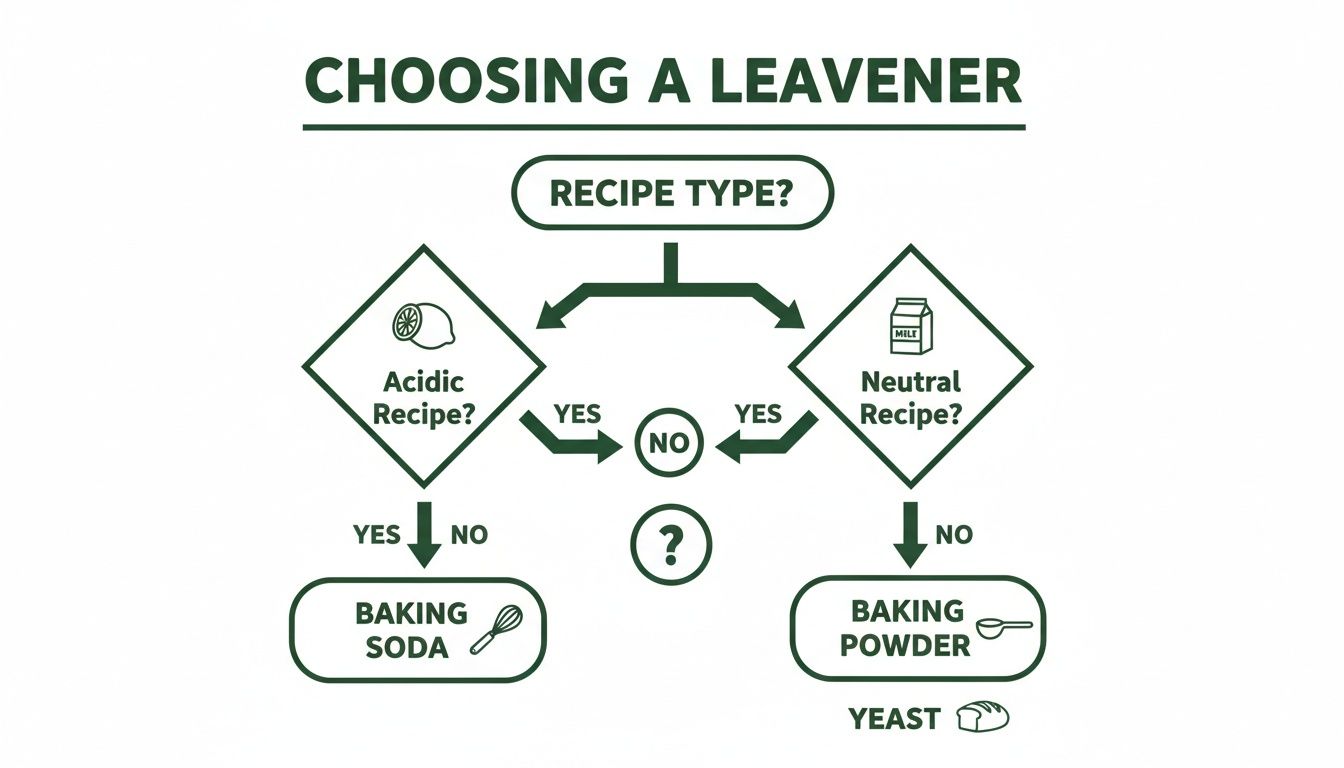
As you can see, the path is clear: if you’ve got acidic ingredients, you'll want baking soda. If your ingredients are mostly neutral, baking powder is the way to go.
Choosing Baking Soda for Acidic Recipes
Baking soda truly comes alive in recipes with strong, acidic flavors. It doesn't just provide lift; its alkaline nature also balances out the taste, making sure your final bake isn't overwhelmingly sour. It’s the secret behind the perfect tang and tender crumb of classic buttermilk biscuits or the deep, rich color of a devil's food cake.
One thing every baker needs to remember is that baking soda's reaction is fast and furious. The second your wet and dry ingredients meet, the leavening process kicks off. To get the best rise, you need to get that batter or dough into the oven right away to trap all those precious air bubbles.
Reaching for Baking Powder in Neutral Recipes
So what if your recipe doesn't have an obvious acid? This is where baking powder gets its chance to shine. If your ingredient list is full of neutral players like whole milk, all-purpose flour, sugar, and butter, there’s nothing for baking soda to react with.
Baking powder is your go-to here because it’s a complete leavening package—it brings its own acid. This makes it perfect for a ton of common baked goods.
To see this in action, here’s a quick look at which leavener you’ll find in some common recipes.
Recipe Use Cases: Baking Soda vs. Baking Powder
Recipe Type
Common Leavener
Reason (Presence of Acid)
Buttermilk Pancakes
Baking Soda
Buttermilk provides the necessary acid.
Classic Sugar Cookies
Baking Powder
The recipe is neutral, lacking a strong acid.
Chocolate Chip Cookies
Baking Soda & Powder
Brown sugar (acidic) reacts with soda; powder gives extra lift.
Lemon Yogurt Loaf
Baking Soda
Both lemon juice and yogurt are acidic.
Fluffy Vanilla Cake
Baking Powder
Milk and butter are neutral, requiring a self-contained leavener.
Devil's Food Cake
Baking Soda
Natural cocoa powder is acidic.
This table shows just how much the other ingredients dictate your choice of leavener.
Because most baking powder is double-acting, it gives you a steady, reliable rise. The first reaction happens when it gets wet, and the second gets triggered by the heat of the oven. This two-stage lift makes baking powder much more forgiving, buying you a little extra time between mixing and baking. By taking a quick look at your ingredients first, you can choose the right leavener with confidence and sidestep those frustrating baking fails.
How to Make Smart Substitutions
We’ve all been there: halfway through a recipe, you reach into the pantry only to find you’re out of a key ingredient. When it comes to leaveners, a missing box doesn’t have to derail your baking plans. With a little kitchen chemistry, you can make a smart swap and save the day.
The crucial thing to remember is that you can't just swap them one-for-one. Baking soda is about three to four times stronger than baking powder. If you try to use baking powder in place of soda, you'll need to add a lot more to get the same lift, which can unfortunately leave a bitter, chemical aftertaste.
Substituting Baking Powder for Baking Soda
If a recipe calls for baking soda, it’s because there’s already a key acid—like buttermilk or lemon juice—in the ingredient list. When you substitute with baking powder, you're introducing another acid, which can throw things off.
- The General Rule: Use 3 teaspoons of baking powder for every 1 teaspoon of baking soda called for.
- The Catch: This swap is best reserved for recipes with strong, forgiving flavors. In a delicate vanilla cake, for example, the extra acid and metallic tang from that much baking powder can be a real dealbreaker.
Creating Your Own Baking Powder
A much better, and more common, solution is making your own baking powder from scratch. It’s surprisingly simple and gives you far more control over the final taste and texture. All you need is baking soda and a dry acid, usually cream of tartar.
The DIY Formula: To make your own baking powder, combine 1/4 teaspoon of baking soda with 1/2 teaspoon of cream of tartar. This creates the equivalent of 1 teaspoon of commercial, single-acting baking powder.
Precision is everything here. Baking is a science, and even small measurement mistakes can lead to big disappointments. If you're ever in doubt, a kitchen scale is your best friend. Our guide for converting cups to grams is a great resource for getting those numbers just right.
Just keep in mind that this homemade version is single-acting. It starts working the second it hits the wet ingredients. So, once you mix everything together, don't dawdle! Get that batter into the oven quickly, or you’ll lose all that precious lift while it sits on the counter.
Keeping Your Leaveners Fresh And Active
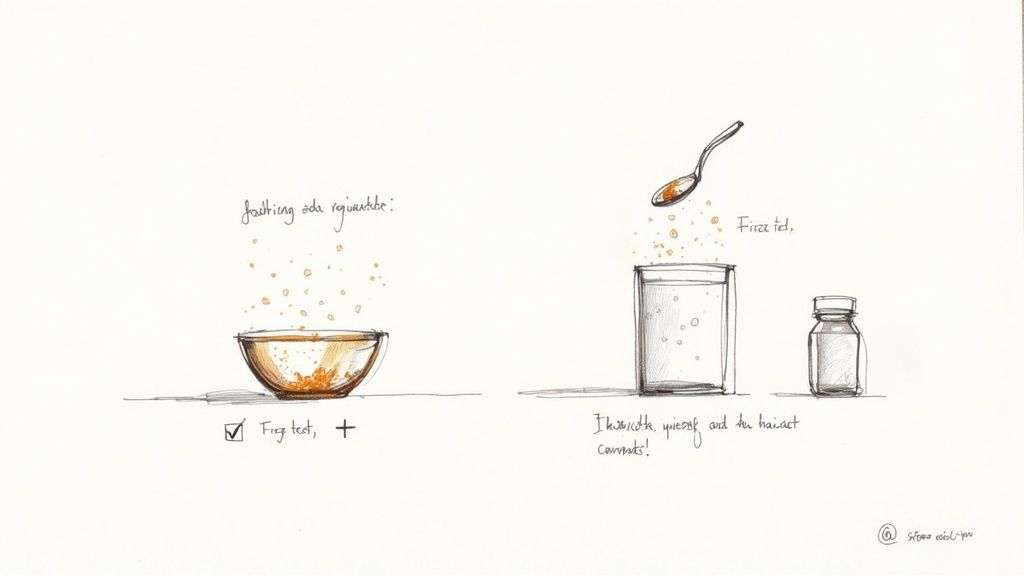
There’s nothing more frustrating than a cake that falls flat or cookies that come out like hockey pucks. More often than not, the culprit is a leavener that's lost its oomph. Before you even pull out the mixing bowl, it's worth taking a minute to check if your baking soda and baking powder are still up to the task.
Luckily, you don't need a science kit to figure this out. A quick fizz test will tell you everything you need to know.
How To Test Your Leaveners
Here’s how you can quickly check if your leaveners are still active and ready to work their magic.
- Testing Baking Soda: Put about half a teaspoon of baking soda into a small bowl. Add a splash of an acid, like vinegar or lemon juice. If you get an immediate, vigorous fizz, you're good to go.
- Testing Baking Powder: Drop half a teaspoon of baking powder into a little hot water. Because baking powder already contains an acid, the water is all you need to trigger the reaction. If it bubbles up enthusiastically, it’s still fresh.
If you see only a few lazy bubbles—or worse, nothing at all—it's time for a new container. That little test just saved your recipe.
The biggest enemy of any leavener is moisture. Once humidity gets in, it starts a slow reaction that drains its lifting power long before it ever makes it into your batter.
The secret to longevity is proper storage. Keep both baking soda and baking powder sealed in airtight containers. Store them in a cool, dark, and dry spot like a pantry or cabinet, far away from the steam of the stove or dishwasher.
For more great tips on keeping all your staples in top shape, check out our guide on how to organize your kitchen pantry. And if you want to dive deeper, this guide on how to properly store food to extend its shelf life is a fantastic resource. A little care goes a long way in ensuring your ingredients deliver that perfect rise, every single time.
Frequently Asked Questions
Even when you feel like you've got the hang of baking soda and baking powder, a few tricky questions always seem to pop up. Let's walk through some of the most common ones so you can bake with total confidence.
Can I Use Both Baking Soda And Baking Powder In The Same Recipe?
Absolutely! In fact, many recipes demand it. Things like chocolate chip cookies and certain types of cakes often call for both leaveners to get the perfect texture and browning.
Think of them as a team. The baking soda gets to work neutralizing an acid in the recipe (like buttermilk or brown sugar), which not only helps with lift but also deepens the flavor and color. The baking powder then steps in to provide the rest of the heavy-duty, sustained lift needed for that light and airy crumb.
Why Does My Cake Taste Soapy Or Metallic?
That dreaded soapy or metallic aftertaste is a dead giveaway: you have leftover, unreacted baking soda in your bake. This happens when there isn't enough acid in the batter to neutralize all the alkaline baking soda you added.
This is why precise measurements are so critical in baking. A soapy taste is a sign that the chemical reaction didn't fully complete, leaving that unpleasant flavor behind.
A soapy flavor is a direct signal that the recipe's chemistry is off balance. Double-check your measurements or ensure acidic ingredients like yogurt or buttermilk are fresh and potent enough to do their job.
What Is Double-Acting Baking Powder?
Great question. "Double-acting" is the standard type of baking powder you'll find on virtually every grocery store shelf today. It’s incredibly reliable and forgiving for home bakers because it works in two distinct stages.
Here’s how it breaks down:
- The First Lift: It releases a small burst of carbon dioxide gas the moment it gets wet in the batter.
- The Second Lift: The real magic happens in the oven. Heat triggers a second, much more powerful release of gas.
This two-phase reaction gives your baked goods a consistent, strong rise, which is essential for creating the light, fluffy structure we all love in cakes and muffins.
Ready to keep all your recipes perfectly organized and accessible? Recipe One uses AI to capture recipes from anywhere—social media, videos, or even a photo of an old recipe card—and saves them in your personal digital library. Stop searching and start cooking with Recipe One.