So, how many cups are in 100 grams? It's a classic kitchen question, but the answer isn't a simple number. The truth is, it depends entirely on what you're measuring.
For instance, 100 grams of granulated sugar is about ½ cup, but 100 grams of all-purpose flour is closer to ¾ cup. The reason for this difference is simple: grams measure weight, while cups measure volume.
Why Converting 100 Grams to Cups Isn't One-Size-Fits-All
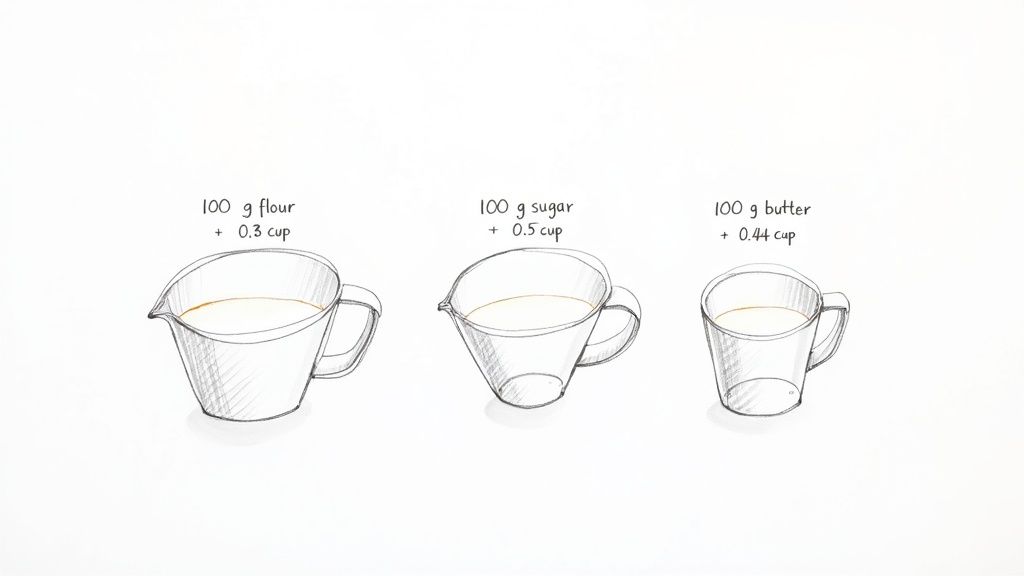
The conversion from 100 grams to cups changes from one ingredient to the next because you're moving between two different types of measurement: mass (grams) and volume (cups). The critical factor connecting them is density.
Think about it this way: 100 grams of something light and airy like sifted flour will take up much more space than 100 grams of something dense like packed brown sugar. Each ingredient has its own unique density, which is why a universal conversion just doesn't work.
Quick Conversion 100 Grams to Cups for Common Ingredients
To save you some time in the kitchen, here’s a handy chart for converting 100 grams of common ingredients into US cups.
| Ingredient | 100 Grams in US Cups (Approx.) |
|---|---|
| All-Purpose Flour | ¾ cup |
| Granulated Sugar | ½ cup |
| Butter | ⅖ cup |
| Rolled Oats | 1 cup |
| Uncooked Rice | ½ cup |
Remember, these are good approximations for when you're in a pinch. For perfectly consistent results every time, using a kitchen scale is always your best bet.
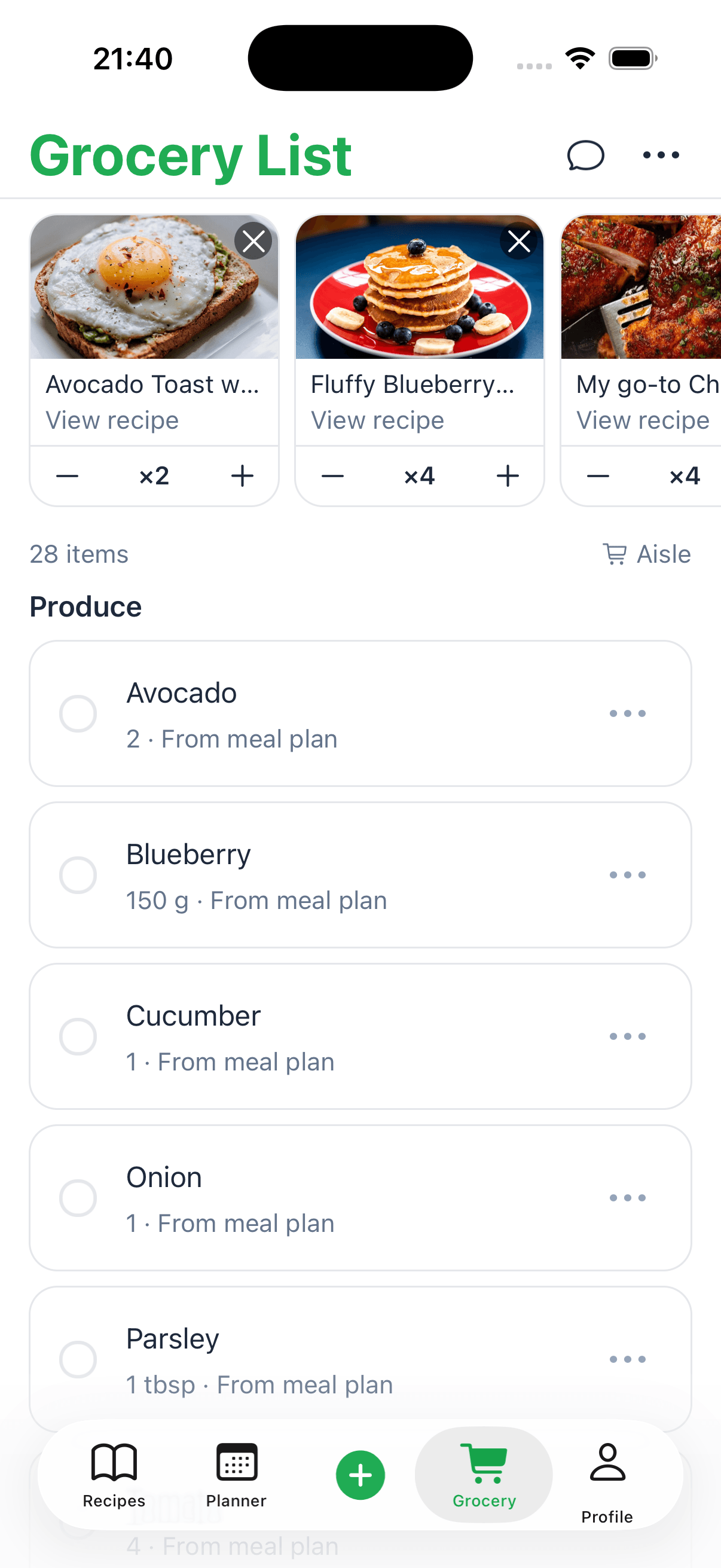
If you need to convert something not on this list, try out the built-in grams to cups converters on Recipe One. They provide instant, accurate answers for hundreds of ingredients.
Why Ingredient Density Is the Key to Accurate Conversions
To really nail the conversion from 100 grams to cups, we have to talk about the difference between weight and volume. It’s a common stumbling block. Grams are a unit of weight (how heavy something is), while cups are a unit of volume (how much space it fills).
The two aren't the same because of one crucial factor: density.
Think about the classic riddle: what's heavier, a pound of feathers or a pound of bricks? Of course, they weigh the same. But imagine how much more space those feathers take up. That's density in action, and it’s the exact same principle we deal with in the kitchen.
Density in Your Ingredients
Let's look at some real-world kitchen examples. A dense ingredient like granulated sugar has small, heavy crystals that pack together tightly. On the other hand, something light and airy like all-purpose flour has much finer particles with a lot of space between them.
This is why 100 grams of sugar is about ½ cup, but 100 grams of flour is closer to ¾ cup. The flour simply takes up more room for the same amount of weight. Every single ingredient has its own unique density, which is why there's no magic, one-size-fits-all number for converting grams to cups.
Key Takeaway: Weight measures mass, while cups measure volume. An ingredient's density is what connects them, telling you how much space a certain weight will occupy.
Take butter, for instance, which is even denser than sugar. You can dive deeper into how its density and water content affect measurements in our guide on how much is in one cup of butter. Getting a handle on this concept is the secret to making your recipes turn out perfectly every time.
The Simple Formula for Converting Grams to Cups

While conversion charts are my go-to for speed, knowing the actual math behind the conversion is a game-changer. It means you can convert any ingredient, not just the common ones. The formula is surprisingly straightforward and just needs one key piece of information: the ingredient's density.
At its core, the formula is:
Cups = Total Grams ÷ Grams per Cup
To make this work, you just need to find the "grams per cup" value for whatever you're measuring. A quick search like "grams per cup of cocoa powder" usually gets you the answer in seconds.
Putting the Formula to Work
Let's walk through a real-world example: converting 100 grams of unsweetened cocoa powder into cups.
- Find the Ingredient’s Density: A quick search tells us that one US cup of unsweetened cocoa powder weighs about 86 grams.
- Plug in the Numbers: Using our formula, we get: Cups = 100 g ÷ 86 g/cup.
- Do the Math: 100 divided by 86 is roughly 1.16 cups.
So, 100 grams of cocoa powder is just a bit over 1 ⅙ cups. This simple process works for anything, from almond flour to zucchini. If you want to get even more comfortable with these conversions, check out our guide to convert recipe measurements for all kinds of situations.
Why Don't All Recipes Just Use the Same Measurements?
Ever find yourself staring at a recipe from a European baker that calls for grams, while your kitchen is full of measuring cups? You’re not alone. This common kitchen problem comes down to a simple, long-standing difference in how we measure.
In the United States, we've stuck with measuring by volume—think cups, tablespoons, and teaspoons. It's a system that became standard in American kitchens a long time ago. Meanwhile, most of the rest of the world moved to the metric system, measuring ingredients by weight in grams and kilograms. This is why converting something specific like 100 grams to cups can be such a headache.
This isn't just a historical quirk; it still shapes how we cook today. A 2020 survey found that over 60% of American home cooks prefer using cups for dry ingredients. That’s a world away from kitchens in Europe and Asia, where a digital scale is just as essential as a mixing bowl. To get a deeper look into this measurement divide, you can learn more about modern cooking conversions.
Digital Scales are Changing the Game
Luckily, bridging this measurement gap is getting easier. Affordable and incredibly accurate digital kitchen scales are becoming a staple in more and more homes, giving everyone a common language for ingredients.
When you weigh your flour, you eliminate all the variables that come with using a cup. Is the flour packed down or lightly scooped? With a scale, it doesn't matter. A gram is a gram, no matter where you are in the world.
As more cooks discover how much more reliable their results are when they weigh ingredients, recipes become foolproof and easier to share. A gram is always a gram, which means an end to the conversion confusion.
Comprehensive Ingredient Conversion Chart
To make life a little easier in the kitchen, I've put together a detailed conversion chart. This isn't just a quick-reference list; it's categorized so you can easily find the exact ingredient you're working with, whether it's flour, sugar, or something else. Think of it as a reliable resource you can bookmark for whenever you need a precise conversion from 100 grams to cups.
The sheer variety in these conversions really drives home why measuring by weight is so much more accurate than by volume. Still, old habits die hard, and this infographic shows just how common volume-based measurements are in many parts of the world.
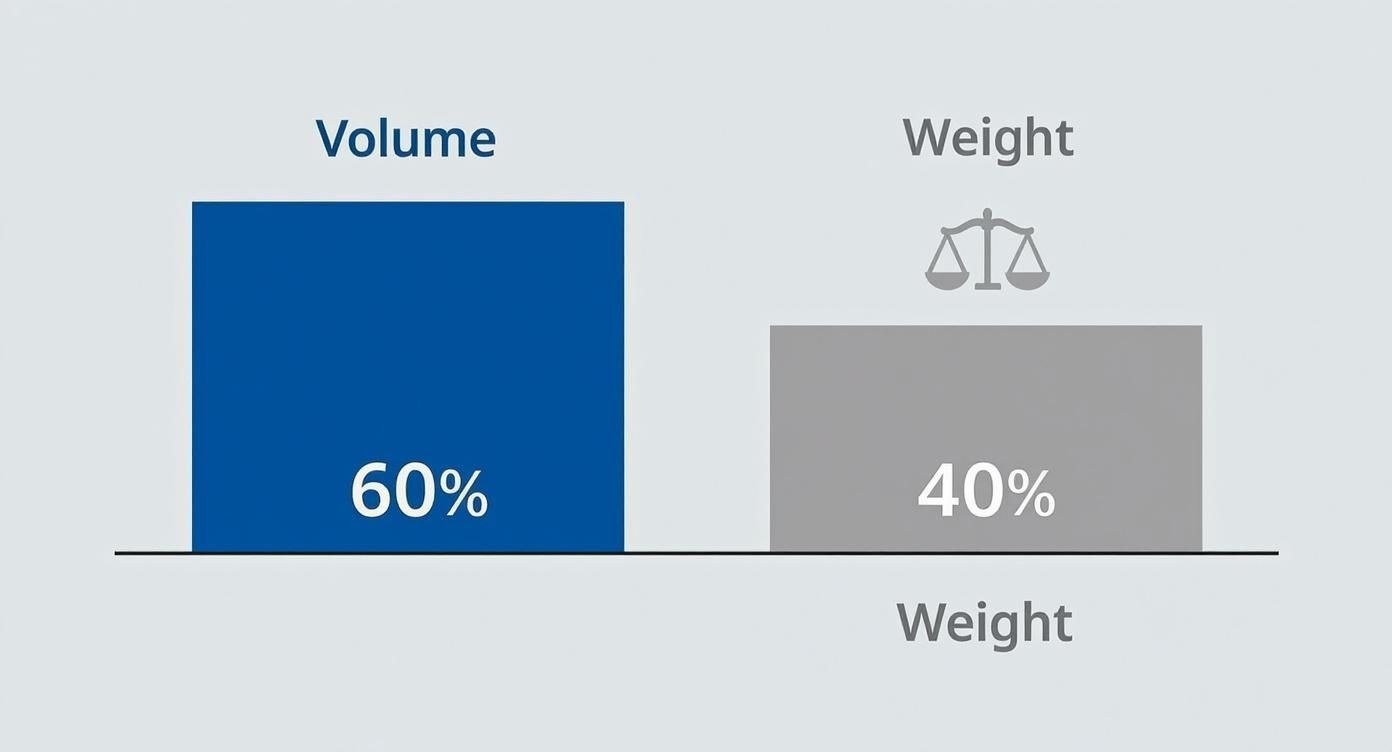
As you can see, while much of the culinary world has embraced the precision of weight, a significant portion still relies on volume. That’s exactly why having accurate conversion tools is so important.
Common Baking Ingredient Conversions
Here’s a table with specific measurements for some of the most common ingredients you'll find in baking and cooking. Take a close look at how an ingredient's density completely changes its cup measurement, even when the weight is a consistent 100 grams.
| Ingredient | Category | 100 Grams in US Cups (Approx.) |
|---|---|---|
| All-Purpose Flour | Flours & Grains | ¾ cup (0.71 cups) |
| Granulated Sugar | Sugars | ½ cup (0.5 cups) |
| Butter | Fats & Dairy | ⅖ cup (0.44 cups) |
| Rolled Oats | Flours & Grains | 1 cup (1.03 cups) |
| Uncooked Rice | Flours & Grains | ½ cup (0.54 cups) |
The difference is striking, isn't it? One hundred grams of light, fluffy rolled oats fill about 1.03 cups, while the same weight of dense granulated sugar is only 0.5 cups. This is precisely why just swapping things out can throw off a recipe. Studies have even shown that a single cup of flour can weigh anywhere from 110 to 130 grams depending on how it was packed!
If you need to go the other way, our guide on converting cups to grams has even more ingredient breakdowns and details.
How to Measure Ingredients for Perfect Results
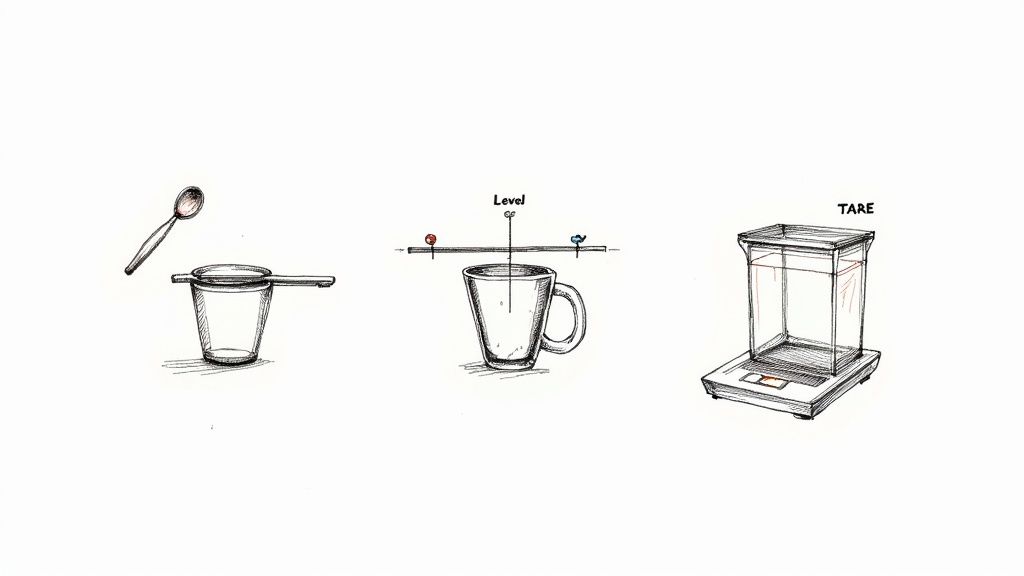
Knowing the conversion for 100 grams to cups is half the battle. The other half? How you actually measure your ingredients. Without the right technique, even a perfect conversion chart can't save your recipe from coming out differently every time.
Getting into a few good habits can make all the difference in your cooking and baking. These simple adjustments lead to more accurate measurements, which means you get that perfectly textured cake or well-balanced sauce you were aiming for. It’s also a key part of learning how to scale a recipe up or down successfully.
Tips for Accurate Measuring
Here are a few tried-and-true techniques that pros rely on to get consistent results.
-
Dry Ingredients (Flour, Sugar): Always use the "spoon and level" method. Don't just scoop the measuring cup into the bag—that packs everything down and gives you too much. Instead, lightly spoon the flour or sugar into the cup until it's overflowing, then sweep the excess off with the flat edge of a knife.
-
Liquid Ingredients (Milk, Oil): For liquids, put your measuring cup on a flat countertop before you pour. Then, crouch down so you're at eye level with the measurement lines. Looking down from above can distort your reading and throw off the measurement.
Pro Tip: If you're using a digital scale, put the empty bowl on it first and hit the "tare" or "zero" button. This zeroes out the bowl's weight, so you're only measuring the ingredient you add.
Common Questions About Kitchen Conversions
Diving into recipe conversions often brings up a few questions, especially when you're trying to figure out 100 grams to cups for the first time. Getting your measurements right is the key to great results, so let's clear up some of the most common points of confusion.
A question I hear all the time has to do with cup sizes. It's easy to assume a cup is just a cup, but that's not always the case. A US cup is different from what's used in the UK or Australia, and that small detail can throw off a recipe if you're not paying attention.
Are US Cups and Metric Cups the Same?
No, and it's an important difference to know. A standard US cup is 240ml. On the other hand, the metric cup used in places like Australia, the UK, and Canada is 250ml.
That 10ml difference might not sound like a big deal, but it can really add up. If a recipe calls for several cups of flour, that small variation can change the texture and consistency of your final dish. For that reason, all the conversions we talk about in this guide use the standard US cup.
Another thing people often ask about is the measuring cups themselves. It’s so tempting to just grab the first one you see, but it really pays to use the right tool for the job.
Using the correct measuring tool is as important as the conversion itself. Dry and liquid measuring cups are designed differently for a reason—to ensure precision.
Liquid measuring cups have that handy spout for pouring and lines that are set below the rim. This design makes it impossible to properly level off dry ingredients. Dry cups, however, are made to be filled right to the top and scraped level. Mixing them up is a classic kitchen mistake that can lead to inconsistent bakes.
What if My Ingredient Is Not Listed?
If you don't see your specific ingredient on our chart, don't worry. A quick search online for something like "[Ingredient Name] grams per cup" will usually give you the density you need. Once you have that, you can plug it into the formula we mentioned earlier to figure out the conversion yourself.
Want to learn more? Check out our guide on how many tablespoons are in a cup to build on your measurement skills. At the end of the day, though, nothing beats a digital kitchen scale for true accuracy with any ingredient.
For seamless recipe management and conversions, try Recipe One. It automatically saves and organizes your favorite recipes from anywhere online and includes built-in tools to make your time in the kitchen easier. https://www.recipeone.app/